Should You Clean Your Roof? — FreePress Directory

It’s always right to think whether you are offering the right maintenance and care for your roof since it’s the most essential barrier between your home and external elements. Neglecting your roof can make it start being damaged slowly, and some of these damages can be expensive to repair and can lead to property damage because of water leakages and mold growth.

Performing an annual inspection and cleaning can significantly prevent long term damage to your roof. In addition to this, a well-maintained and cleaned roof can increase the value of your home.

Inspecting and cleaning your roof

The most important and common task when it comes to roof cleaning is to remove debris from rain gutters. This exercise is essential as it allows rainwater to flow well, and also assists in preventing water from damaging both the interior and exterior of your home. It’s important to note that gutter cleaning is essential when it comes to the inspection and general health of your roof. Spring and fall are the best times when one can do roof inspections and cleaning.

Whenever possible, make sure that you use a ladder when cleaning your rain gutters. While cleaning the gutters, perform a visual inspection of your roof in all the areas that you can see. Check the condition of the gutters, downspouts, shingles, and skylights. You should not ignore any discolorations or dark stains, like water stains—always do an extra inspection when you note such kind of signs. These can be possible signs of areas that require additional inspection or repair, or indications of water infiltration.

The following are a few things that you should include in your roof cleaning and inspection:

Remove the debris from the gutters and downspouts

You can use gloves, a broom, or any light tool to clear the debris out of these two essential systems that direct water away from your roof. The sloping design of a roof, together with the roof valleys allows them to direct rainwater to the gutters. Accumulation of debris on your roof affects the entire roofing system. You should make sure that broken or loose gutters, as well as downspouts, are repaired to make sure that they don’t direct water to the foundation of your home, which can damage it.

Trim all the bushes and trees surrounding your home

Trimming the plants surrounding your home at least twice a year can assist in preventing roof damage. All large bushes and tree limbs should be at least 2 feet away from your home. In addition to this, they should be as far as possible from your gutters to reduce debris. You should not allow climbing plants to grow on your walls or roof. These plants can easily infiltrate the roofing system, cause water blockage, and thus lead to water damage like rot and mold growth.

All the dead branches on the trees surrounding your home should be removed before they become a potential hazard to the roof. A tree with poor health must be removed to prevent it from falling on your roof in the event of a storm. You can consult an arborist for expert advice if you are in doubt about this.

Check for blocked or clogged vents

This will assist you to make sure that the ventilation system in your roof is functioning properly. To do this, you must ensure that you perform a visual inspection of all the ventilation and fixtures in your roof. You shouldn’t forget to inspect the soffit vents, which are vertically located on the sides of your home, or horizontally under your roof’s eaves.
Blockage on your roof’s vent openings can lead to rotting, warping, on the walls or roofing, as well as moldy eaves. If this issue is left unattended for a long period of time, it can lead to costly repairs, or demand a new roof to be installed, which can also be expensive.

Check for bent, broken, or loose flashing

Now, if you are wondering what flashing is, it’s the metal that’s used to close the gaps in between the components of your roof. Mostly, flashing is used around the edge of the vents and chimney, the roof’s ridge, as well as along the gutters and eaves. Flashing serves a very important role in your roof, as it makes it resistant to water and wind intrusion.

If you realize that any of the flashings are not property function, make sure that they are repaired immediately to avoid any additional damage during rain, wind, or heavy snowing. If the flashing is loose, it can be easily secured back to its place. However, you should always contact an expert in roofing to work on your flashing to avoid damaging them further.

If you own a home with two or more stories, it can be impossible to see the rooftop with a ladder. If you realize that you cannot inspect your roof or work around it personally, the best thing to do is to contact an expert in roofing to perform the inspection on your behalf.

Important things to consider during roof maintenance and cleaning

Once you clear your roof from debris, you can test the entire roofing system with a water hose. You should avoid using the hose if the system has debris to avoid clogging the entire drainage system. The aim of this test is to check whether the water is flowing into the gutters as it should and whether the downspouts are functioning well. If you notice water pooling on your rooftop, then the system is not yet clear.

Is your roof still dirty? If that’s the case, it will require more than a hose-cleaning. The following are a few things that you should put into consideration:

  1. The roofing materials will start to show signs of weathering over time. You need to look for areas that look warped or moist, instead of weathered or aged. The greatest enemy of your roof is long term localized moisture, and you should always check your roof for this.
  2. If your roof has algae, moss, or stains that make it appear unattractive you can clean it gently with a biodegradable cleaner to prevent moss from growing and also assist in extending the lifespan of the shingles. If you have asphalt shingles, you can clean them using normal household cleaning items, but you can also consider hiring a cleaning expert to clean the roof. You should note that installing zinc or copper flashing can assist in reducing algae and moss growth since they naturally have antifungal components that protect it from such growths. Stains caused by algae are common in areas with high humidity.
  3. Certain roofing materials come with the manufacturer’s guidelines in regards to regular maintenance and cleaning. It’s advisable to follow these guidelines if you want your warranty to be valid.
  4. Today, we have modern roofing materials that are more durable, weather-resistant, and last for long. Most of today’s roofing materials are mold, algae, moss, and mildew resistant. For instance, metal roofing lasts for long, requires minimal maintenance, and resists mold, algae, and moss growth naturally. However, it’s a good idea to make sure that you enquire about the durability and maintenance of your roofing material before buying it.

You should note that roof work is risky and dangerous, and its work needs a person to climb to the roof. Therefore, it should only be done by a person with proper safety equipment, as well as one who knows how to avoid damaging the roof. The best way to keep your roof in good condition is to hire an expert in roofing services, who should offer regular maintenance and scheduled inspections to assist in protecting your valuable investment.

Never pressure wash your roof

Certain roof cleaning companies normally promise their clients that they can pressure wash their roof, and give it a brand new look. However, pressure washing can cause significant damage to your roof, especially when you’ve used tiles or asphalt for your roof, as their components can be moved out of place by the strong pressure. When you spray pressurized water from your roofline edge can lead to an uplifting force of water below the tiles. Even though pressure washing can be an effective method to clean your roof, it can lead to costly benefits, in the long run, particularly the substructure of the roof.

If you need to wash your roof, look for a roof cleaning company, such as Rain-Go Exteriors, that uses biodegradable cleaning solutions, with normal water pressure only.

source https://www.freepressdirectory.com/should-you-clean-your-roof/

Roof Preservation and Restoration for Self-Storage Buildings — Inside Self-Storage

Just like owners of other commercial businesses, self-storage operators are subscribing to a new, forward way of thinking when it comes to roof maintenance. The emphasis is on repair and restoration over replacement, which is expensive and can be disruptive. Now, replacements are done only when there’s no other option.

Run-to-failure is an old way of thinking that no longer works. Today’s facility operators exhaust all efforts to extend the life of their roofs. They understand the value of planned, smaller investments such as semi-annual inspections and gutter-cleaning performed by a qualified technician. They don’t ignore the roof, thinking they’re saving money along the way. They make it a priority to minimize the risk of a major problem by intervening in a timely manner with professional repairs and restoration.

A wave of innovation in the roofing industry has helped foster this proactive approach. When you get in front of problems before they occur or escalate, you can maximize the useful lifespan of your roofs. Spending a little upfront can prevent a major capital expense from hitting you when you least expect it.

Can It Be Repaired?

Every roof will spring a leak at some point. And all leaks, no matter how big or small, need to be resolved quickly to prevent them from evolving into larger issues such as slip-and-fall risks, mold from wet insulation, damage to tenant goods, insect infestation, higher utility costs and others.

Think of your roof as a car. If your car started making a strange noise, would you automatically sell and replace it with a new one? Probably not. Most likely you’d have a mechanic take a look to determine the cause of the noise and the best way to resolve it, hoping for a quick, cost-effective solution.

At the onset of a roof problem, the first course of action should be to contact a trusted roofing contractor. Explain what’s happening and your plans for the buildings to help the company determine the most economical, durable solution for your needs. Typically, repair is the cheapest option and the quickest way to resolve a problem. When possible, it’s the ideal way to extend the useful life of the roof.

Self-Storage-Roof-Vross-2019.JPG

Restoring to ‘Like New’

As a roof approaches the end of its projected useful life and repairs become too frequent and cost-prohibitive, it’s time to consider a restoration. Too often we see roofs being replaced when a refurbishment is all that’s needed.

Intervening with a restoration at the right time can save as much as half the cost of a complete tear-off and replacement, and it can be just as effective at bringing the roof to watertight condition and back under a long-term warranty. In addition to cost-savings, restoration results in far less disruption to your tenants and business operation. It also creates far less landfill waste than a replacement.

Another benefit is restorations can be done on individual roof sections. A self-storage facility might only need a troublesome area fixed, or one or two buildings. Furthermore, the process can be repeated many times, resetting the clock on the warranty and watertight condition, and once again allowing you to delay replacement.

Bear in mind that restorations are only possible for certain roof types, including metal, with specific types of damage. If a roof has too much wet insulation, for example, it can’t be restored. Some roofs are simply too far gone.

The Final Option

In some cases, the roof is in such disrepair and the system has outworn its useful life to such a degree that a replacement is the only logical choice. If that happens, there are many factors to consider such as climate, building type, warranty length and more. There are many roof systems on the market, but with modern technology, we now know more about the materials and systems that work best in specific circumstances.

Trust in a provider that’ll be open-minded and honest about your options when assessing your roof. Find one who shares in a philosophy of extending roof life vs. automatically settling on a costly replacement.

Practicing proactive roof repair and restoration can allow you to better manage your overall budget. When your roof costs are under control and more predictable, you can confidently assign dollars to other projects.

Anthony Vross is a co-owner of Simon Roofing, a national roofing manufacturer and contractor. The company provides roof-asset management, evaluation, preventive maintenance, repairs, restoration and replacement. For more information, call 888.353.7178; visit www.simonroofing.com.

Self-Storage-Roof-Leaks-Sidebar.JPG

source https://www.insideselfstorage.com/building-componentsmaterials/roof-preservation-and-restoration-self-storage-buildings

Brick planter should not be built against the house — Chicago Daily Herald

Q: Last year, I built a brick planter against the front wall of my home. Now that I’m selling the property, the termite inspector says there should be an air space between the planter and the building to prevent moisture damage in the wall. This seems unnecessary because I installed sheet metal behind the planter for the very purpose of preventing moisture problems. I explained this to the termite inspector, but he says the air space is still required. Can you please settle this matter? What are the requirements for building an attached planter?

A: When you installed sheet metal flashing behind your planter, you were only partially in compliance with applicable codes. Planters that are installed against a wood frame building must have flashing, but requirements also include a 2-inch air space between the planter and the building. Sheet metal must be used in conjunction with, not in lieu of, this air space. Without the flashing, a 6-inch separation from the building would be required.


The use of flashing, without an air space, presents two potential problems:

• Sheet metal flashing between the planter and the house is a temporary barrier only. Continued moisture exposure to the sheet metal leads to eventual rust damage. Thereafter, moisture from the planter would have a direct path to the wood-frame wall;

• Even when the sheet metal is intact, it can only prevent moisture penetration from the planter itself. The upper edge of the flashing remains exposed to water intrusion from direct rainfall or irrigation. Any water that drains between the flashing and the wall surface can promote fungus damage and mold.

Obviously, it is too late to provide an air space behind a brick planter that is already built. Your termite inspector may suggest some alternate methods to minimize the potential for moisture intrusion. For example, you could put potted plants into the planter.

Q: I converted my attic to make two additional bedrooms. At the time, I thought everything was done to code. Since then, I’ve learned that the 7-foot-high ceilings are too low, and the 18-inch by 24-inch windows are too small. Are code requirements different for attic bedrooms? If not, how will this affect me when I sell my home?


A: Codes affecting ceiling heights and bedroom window dimensions are the same, regardless of where the rooms are situated. Hence, your converted rooms do not comply as legal bedrooms and cannot be represented as such when you sell the property. However, you may be able to salvage the situation.

Replacing the windows with larger ones is probably not too difficult. It may also be possible to reframe the ceilings to the required height. If so, you might consider applying to your local building department for an as-built permit. This would afford you the opportunity to bring the added bedrooms into compliance, thereby increasing the value of your home.

If you leave the rooms as they are, your only obligation at time of sale is to fully disclose to buyers the current status of the attic as functional but noncomplying bedrooms.

• To write to Barry Stone, visit him on the web at http://www.housedetective.com, or write AMG, 1776 Jami Lee Court, Suite 218, San Luis Obispo, CA 94301.

© 2020, Action Coast Publishing

source https://www.dailyherald.com/entlife/20200209/brick-planter-should-not-be-built-against-the-house

Ranking Every Boss Fight In Control (& How To Beat Them) — TheGamer

Control lets the player devastate the Hiss through immense power and a multi-functional gun. Jesse Faden can launch objects at her enemies, shield herself, and transform her gun into a variety of different firing modes. Even with great power, some of the bosses can be a pain to deal with.

RELATED: 10 Hidden Plotlines Everyone Missed In Control

The bosses are all unique in both their function and their introduction. Faden finds one boss by walking through a mirror and another by interacting with a flamingo. Some of them are required while others are optional. They all present a challenge, though some are tougher than others!

advertising

7 Horowitz

It’s entirely possible to complete the game without running into this boss. Horowitz can be found bleeding on the ground in the Containment/Logistics section on the far left side of the map. Faden is tasked with finding a medic through a side mission, but once she is back Horowitz is completely controlled by the Hiss. He never calls in reinforcements and does not have any special moves.

Horowitz is easy to pin down by spamming launch until Faden’s energy runs out. Once that happens switch to the service weapon and fire until it’s time to reload. Repeat this process until he is dead. The boss uses a basic weapon that doesn’t require any special dodging. Horowitz is also kind enough to drop health when he is damaged.

6 Anchor

The Anchor is one of those strange optional bosses. It can be found after Faden completes the above mission with Horowitz. It’s also a part of the «Langston’s Runaways» quest. Faden will find herself in a room filled with clocks. There is a shelter in the room that leads Faden to the boss battle. She will find herself in a big square room with a giant hole in the middle and four platforms, one on each side. A big sphere will rise from the middle and start shooting clocks out of its mouth.

The sphere will turn to a platform, charge up, then throw up some clocks. It will repeat this on every platform. The trick is to launch projectiles into its mouth while it’s charging up. Make sure to launch before the clock throws up because it can cause serious damage. After Faden launches a projectile, one shot will work fine, levitate to another platform and wait for the sphere to turn to that platform and start charging up again. Just keep repeating this process and the anchor will go down easily. Smaller enemies will start to spawn, but if you keep moving then they won’t be much of a problem. Plus, they are stupid enough to be lured into the sphere’s firing range.

advertising

5 esseJ

This boss is part of the clever side mission: «Self-Reflection.» The mission can be found by picking up a collectible during the main mission, «The Face of The Enemy.» Faden has to complete a small puzzle to enter a containment cell holding a mirror. She can enter the mirror, which turns the world into a reflection. Jesse Faden will run into esseJ, the reflection of herself. The boss has all the same powers as Faden making for an interesting encounter.

RELATED: 10 Things Everyone Completely Missed In Control

The fight has three stages. In the first one, esseJ runs around shooting from the service weapon. She’ll switch between the automatic fire of Spin and the rockets of Charge. This is the easiest stage because the rockets can be redirected using launch. The combination of shield and evade is an easy way to avoid damage. The second stage has esseJ using shield launch, and the gun. The typical tactic of launching projectiles to lower the shield then firing with the service weapon works well here. It’s also easy to avoid damage by using evade. Last stage esseJ uses levitate, launch, the gun, and ground slam. Focus on using evade to dodge projectiles and your gun.

4 Salvador

Salvador is the second boss in the game. Faden’s lack of power at the time can make him somewhat difficult. He has a slurry of rubble swirling around him, which creates a persistent shield, and he will throw projectiles at you. The most difficult part may very well be the foot soldiers. They can be an annoyance while Faden’s true enemy is gearing up to attack. The darkness and red glare of the room can also turn the fight into a chaotic mess. Not to mention all the rockets and grenades flying about.

Keep moving, and take out all the annoying smaller enemies. If Faden is stationary, then she will be bombarded with rockets and launched projectiles by Salvador. This way Faden can have easy access to health when an enemy is defeated. The only reason to stay stationary is to use cover to block the launched projectiles. Siege is another helpful way to decrease enemy numbers but most importantly it causes a slight distraction — directing fire at someone else besides Faden. The main man, Salvador, can be damaged after his shield is taken down. Use launch repeatedly to do this then fire your weapon once he is no longer shielded.

advertising

3 Mold-1

Mold-1 is the climax of one of the most annoying sets of missions in Control. Faden is tasked with finding Dr. Underhill in the lower depths of Central Research. Work through the «Old Growth» side mission, fighting through mold creatures until you reach Mold-1. This is a giant plant that will strike with his «arms» and shoot a series of poison darts.

Its weak spot is the obvious blue sphere on its head. Equip your weapon with headshot damage to cause the most damage. Levitating combined with evade is the best way to avoid the darts. Plus, Mold-1 will poison the ground and levitate is the only way to get out of the way. Use the jutting rocks to block Mold-1’s hits. This one may take a few tries. If you get too frustrated, Eurogamer provided a helpful tip. If you hide behind the large rock slightly to the right of the room, Mold-1 will not attack.

2 Former

Former can be found after Faden interacts with a fridge during the «Fridge Duty» quest. The boss actually shows up again after interacting with a flamingo. Former will shoot balls out of its eye and try to hit you with its several arms. The difficulty comes with the environment. As the battle rages on the cover will be destroyed and the floor will start to fall apart. It’s far too easy to fall to your death as the platform gets smaller and smaller. This makes it difficult to dodge and its almost impossible to watch Former and the platform your standing on at the same time.

RELATED: 10 Things That Make No Sense About Control

It’s best to constantly fire into the worm’s eye. The worm’s balls can be destroyed with the service weapon easily. Make sure to mod your weapon with reload efficiency and similar upgrades. Levitation helped with not falling through the ground. Just make sure to look down before you land. Lastly, launch will cause the most damage to the worm’s eye.

advertising

1 Tommasi

This is the first boss in the game, but he appears at the end as well. Tommasi is found, first, by following the main story. The first encounter is not too difficult. Faden can go to the left or right side of the room, underneath a balcony and behead a pillar. This will block any projectiles while Faden shoots from behind cover. Tommasi appears again after beating the main story. Go talk to Emily Pope and she’ll send you on a mission, which involves a rematch with Tommasi.

The second Tommasi is powerful and can kill Faden within two hits. He also dodges most attacks. Pierce is the most effective weapon against Tommasi. It’s the one thing he finds difficult to dodge. If Faden launches consecutive objects, he can’t dodge all of them. The most important part is dodging Tommasi’s launch attacks. Like usual, hide behind cover to avoid these. Another annoying part of this fight is the foot soldiers, specifically the distorted. These are invisible Hiss that can sneak up on you and initiate a devastating attack. Focus on killing this foot soldier first- the shield is a good way to protect from its attacks.

NEXT: The 5 Best & Worst Things About Remedy’s Control

<![CDATA[

]]>

Next The 10 Best & Powerful Temtem, Ranked

source https://www.thegamer.com/control-every-boss-fight-ranked-tips/

Adrian Plaza building condemned — The Daily Telegram

Family Dollar, Adrian Barbell closed until renovations are made

ADRIAN — Two businesses on Maumee Street are temporarily closed following condemnation of the Adrian Plaza by the city.

The building that houses Family Dollar, 408 W. Maumee St., and Adrian Barbell Company, 416 W. Maumee St., was condemned last week by Adrian Building Inspector Tony Nicholas due to multiple issues stemming from a leaky roof.

The property owners were first cited on Nov. 22, 2019, for a leaking roof, stormwater damage and mold, among other related issues. A notice of violation gives a property owner 30 days to rectify violations.

Henagan said the notice was sent and received by certified mail, but the city heard «no response whatsoever» from the owners. The notice asked that the roof and water damage be fixed.

Henagan said «severe leaking» has persisted for months. The leaking has caused ceiling tiles to fall. There has been standing water observed on shelves and the floor. Mold is also an issue.

A civil infraction, or court order to comply, was issued on Jan. 8. All the while, the city continued to receive complaints from the public about the condition of the building, especially Family Dollar.

An inspection last week revealed matters were only getting worse, according to Henagan, and lead to the condemnation.

The attorney said the roof is in such a state of disrepair it is at risk of collapsing. Moisture is at risk of infiltrating the electrical systems, as well.

As of 5 p.m. Friday, both businesses were prohibited from operating until violations addressed.

Henagan said the condemnation notice was posted earlier last week, even though it did not take effect until Friday evening. This was to give the community advance notice as Family Dollar is a popular, within walking distance store for people at Share the Warmth and Riverview Terrace.

«We let them know ahead of time to give them the best notice we could,» Henagan said.

Owners reached out following the building being condemned and expressed an interest to get it back up to code, the attorney said.

Owners will have to obtain a new permit, replace the roof and fix any and all interior water damage, including dry wall and ceiling tiles. A licensed professional will have to remediate the mold and an air quality report will have to be conducted before either business reopens.

Henagan said the owners have the option to make the changes on a tenant by tenant basis. For example, the owners can renovate Family Dollar first so it can reopen and be available for nearby residents.

«The ball is in their court, basically,» Henagan said.

source https://www.lenconnect.com/news/20200204/adrian-plaza-building-condemned

Ask Angie’s List: When is it time to replace my carpet? — WV News

Eventually, even the best-laid carpets must be replaced. While regular upkeep can increase your carpet’s lifespan, most manufacturers estimate you’ll need a full replacement after about 10 years. And the signs you need to start shopping around aren’t always obvious. Here are a few ways you can tell your carpet is reaching the end.

Stains won’t come out

Whether it’s from spilled wine or a new puppy, there are some stubborn stains that even professional cleaning can’t get rid of. If they’re minor, you can typically hide them with area rugs or furniture. But if the damage is permanent and unsightly, it’s probably time to look for new carpeting. Homeowners typically pay between $760 and $2,540 to replace a carpet, according to the Angie’s List Pricing Guide. Per square foot, carpet materials usually cost an average of $2 to $7, though price can fluctuate depending on quality.

Foul odors won’t go away

If you notice that deep cleans just aren’t banishing the bad smells, that likely means the issue isn’t in your carpet alone — it could be in the padding or floor beneath the carpet. How you handle the problem depends on the type of smell. If your pet is the root cause of the issue, you’ll likely need a full replacement. If you notice a musty smell, that could mean you have a water or mold problem. In that case, carpet replacement may be necessary after a mold remediation specialist takes a look at things.

There’s visible damage

Carpet damage can range from smaller issues, like a burn mark or two, to extensive problems like the mold damage mentioned above. If there’s just a small area where the carpet is frayed, it’s possible for a flooring pro to help you patch it up. If your entire carpet was flooded with dirty water, or clean water flooding has taken a long time to dry out, replacement is the best course of action. A pro can also let you know if the damage extends to the floor beneath your carpet, and how to fix the problem before it creates bigger problems.

You have increased allergy symptoms

It can be difficult to remove dust, pet dander and pollen that embeds in carpet fibers over time. If you or your loved ones notice more sneezing, itchy eyes or coughing, it may be that the problem is beneath your feet. The Mayo Clinic recommends using a vacuum with a high-efficiency particulate air (HEPA) filter or opting for linoleum or hardwood if you’re truly concerned. It costs about $180 for carpet cleaning, via the Angie’s List Pricing Guide, and it’s worth a try before replacing the carpet.

The carpet is old

At a certain point, patching and deep-cleaning your carpet isn’t going to do the trick. If you notice matting, fading color or that the padding just doesn’t feel like it’s there anymore, it’s probably time to move on. If you see ripples or wrinkles, it is possible to have your carpet re-stretched. This is a more expensive repair, so discuss with a carpet pro whether or not it makes sense to fix the issue or get a complete replacement.

source https://www.wvnews.com/ask-angie-s-list-when-is-it-time-to-replace/article_49ac1a32-d00b-5dd6-965c-064702e0f4aa.html

‘Southern Charm’: Why Has Craig Conover Been Unable to Return Home for Almost a Year? — Showbiz Cheat Sheet

Craig Conover from Southern Charm has had a busy travel schedule. From his popular Sewing Down South “pillow parties” to vacation time with friends, Conover hasn’t been hanging at home very often.

While he may be busy there is another reason why Conover hasn’t been nesting. He recently shared to his Instagram story that he hasn’t been able to move back to his home after massive water damage sent him packing. The water damage hasn’t been resolved because Conover’s insurance company refuses to process his claim.

Cameran Eubanks, Craig Conover

Cameran Eubanks, Craig Conover

Cameran Eubanks, Craig Conover | Heidi Gutman/Bravo/NBCU Photo Bank/NBCUniversal via Getty Images

After fighting with the insurance company, Conover voiced his concerns on his Instagram story. Conover began by tagging State Farm and also said he hoped he didn’t have to resort to Instagram to get the insurance company’s attention. He also gave fans a glimpse into his soaked home, which is clearly an unsuitable living space.

Conover asks for help

Conover said he resorted to his Instagram story after receiving another letter denying his claim. “State Farm, please contact me,” Conover pleaded. “I’m sorry to have to do it over this platform but I have been out of my house for nine months and one of your local adjusters just sent me a threatening letter denying coverage.” Conover told Showbiz Cheat Sheet the water damage came from a pipe that burst after a plumber worked on it.

Craig Conover Instagram story

Although this is a serious matter and Conover is likely very frustrated, he seems relaxed and smiling in the video. Like many customers, Conover has been paying his insurance premiums and now he needs help. “I’ve had you guys for a long time, but this is insane. I had water damage nine months ago. I’m still out of my house.”

He then shows a pair of sneakers that are covered in mold to the camera. “Here are shoes that are covered in mold because the house is still soaking wet,” he exclaims. “And your local people are saying that it’s dry.”

Conover was in the process of working on the home

As he walks through the home, he shows that the walls and ceiling are not even covered with drywall. The water damage is so extensive only the interior framework remains and wires dangle from the ceiling. He reiterates that the house is soaked.

“This is my baby that I renovated last year,” he adds. “So please contact me. I don’t want to go any further than this but I can’t seem to get ahold of the right people. Please, please send me a message.” The good news is Conover knows how to repair the water damage once he gets the funds. He shot a “how-to” video on how to repair water damaged floors.

Conover first instructs viewers to remove the water damaged sub-flooring to avoid having mold grow under new wood flooring. He uses a hammer and crowbar to remove the damp subflooring. Conover also advises viewers to avoid “black” mold from growing because after years of having it spread through your home, “You would have eventually died,” he casually remarks.

source https://www.cheatsheet.com/entertainment/southern-charm-why-has-craig-conover-been-unable-to-return-home-for-almost-a-year.html/

Around the House: Despite some claims, it’s best to run a dryer vent outdoors — Colorado Springs Gazette

Dear Ken: The dryer vent in my house runs into the crawl space. Some say it’s good for the house and others say it’s not. What do you think? — Bob

Answer: I’ll side with the latter. Exhausting the dryer into any space except the outdoors adds unwanted and concentrated moisture plus lint. You’d think that, in this dry climate, extra humidity would be desirable. In this case, however, you’re risking damage to your underlying wood floor system and maybe encouraging mold. Plus, the lint can accumulate to such a degree that it chokes your furnace, potentially becoming a fire hazard.

If all that’s not enough, you’re also wasting energy with each drying cycle. Your clothes are taking extra time to dry because the output of the dryer is dumping into moister space than the outdoor air. This also applies to those who use switchable dryer damper box gizmos or those who cover their dryer duct with pantyhose.

Dear readers: I got several responses to an answer I gave a couple of weeks ago in regards to eliminating the cigarette smell from a newly purchased home. I suggested washing the walls, then priming and painting. The feedback I received was from people promoting air purifiers.

A common model relies on moving air through a charcoal mesh and then a HEPA filter in a small portable console. Others produce ozone — the same aggressive form of oxygen you smell after a lightning storm. These seem to work OK, but only in small areas.

There is 15,000 to 20,000 cubic feet of air in the average home. The effectiveness of any circulation setup is based strictly on its CFM, or the amount of cubic feet of air that moves through it per minute. So a small, fan-driven unit is going to have trouble purifying much air in a whole house. Bottom line: It’s better to remove the pollution at the source.

Around the House: Can cheap bookcase be painted?

Dear Ken: You mentioned low-e film on the radio. What is its name and where can you get it? — Van

Answer: It’s available at any home center or hardware store. It’s tinting film and comes with various filtering effectiveness.

You spritz a detergent-and-water mixture onto the cleaned window, squeegee the film to release the moisture and air bubbles, and then trim with a razor blade. The film will reflect out sunlight year-round and will help retain heat during the wintertime.

There is evidence that suggests this film will shorten the life of double-pane windows, so check with the manufacturer if your windows are newer and still under warranty.

Around the House: Tracking down the reason for a leaking toilet

Dear Ken: I’m having recurring sinus problems and wonder about the effectiveness of whole house humidifiers tied to the furnace. — Brenda

Answer: There’s only one style I like. It contains no moving parts and is relatively easy to maintain. Aprilaire is one of a few brands that dribbles water over a honeycombed mesh. Part of the furnace’s airflow then is drawn through the screen, raising its relative humidity.

The evaporating water leaves salt deposits behind, which you can clean with vinegar once in a while; the screen should be replaced annually.

These work pretty well during the heating season. Since they rely on the blower to move air, you’ll need a thermostat that includes an “always on” option. Or, better yet, check out an automatic model. These come with a computer inside the humidistat that takes control of the blower and keeps it on until the humidity rises to a preset level.

One other thing: Make sure the humidifier is installed in an “offset” configuration. That means the unit itself doesn’t sit directly over the furnace. Even the best humidifiers leak, so mounting it on one of the side metal ducts ensures the furnace’s interior is protected.

I’ve found that a good console- style, cold-steam humidifier in the bedroom also works well, so you might consider that before buying the bigger unit.

The furnace version should run $400 to $600, and that price includes installation.

Around the House: Eliminating cigarette smoke stench from walls

Dear Ken: What would you recommend to clean the hard water spots off a shower door? — Jen

Answer: A paste composed of vinegar and baking soda is a tried-and-true homemade method. Barkeeper’s Friend is another effective product; it contains oxalic acid that works well on hard water bathroom blemishes.

Other ideas include CLR (calcium- lime-rust) or Easy Off oven cleaner spray formulations. You can encourage spot removal with any of these products by using a Teflon kitchen scrubber or some very fine steel wool (0000 grit, for example).

Incidentally, I’ve found that one of those daily shower sprays can keep the stall fairly clean when used as recommended on the label.

Ken Moon is a home inspector in the Pikes Peak region. His radio show airs at 4 pm Saturdays on KRDO, FM 105.5 and AM 1240. Visit aroundthehouse.com

source https://gazette.com/life/around-the-house-despite-some-claims-it-s-best-to/article_4ed609c0-479c-11ea-b2b2-8bd2f6363fd6.html

ESD works to put its building back together | News, Sports, Jobs — Alpena News

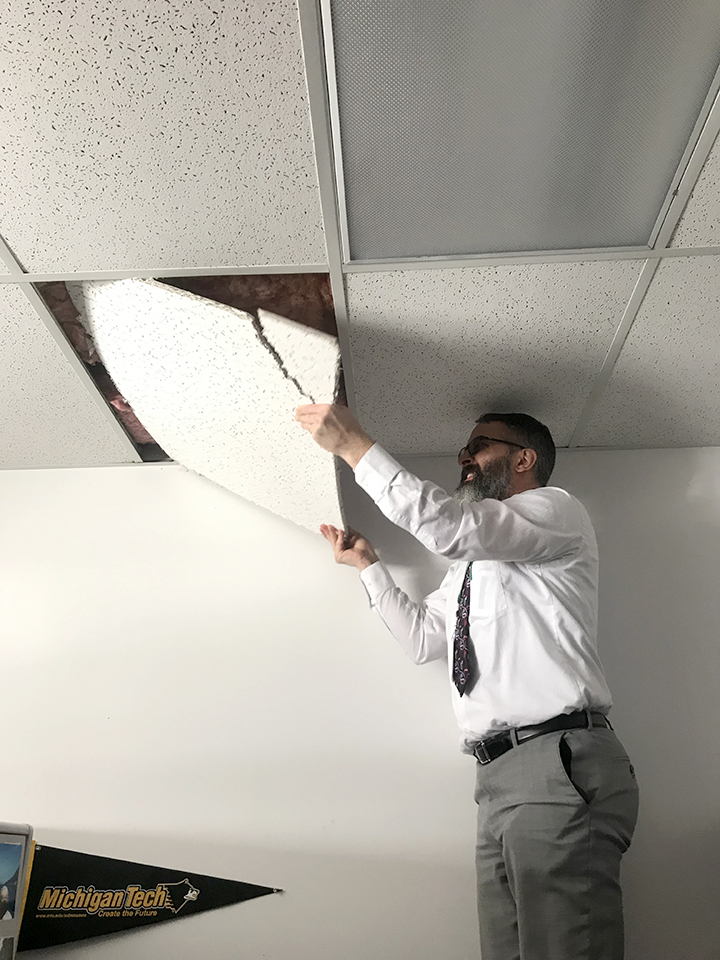
News Photo by Julie Goldberg Scott Reynolds, superintendent of the Alpena-Montmorency-Alcona Educational Service District, on Monday holds a ceiling tile that’s falling apart.

ALPENA — The Alpena-Montmorency-Alcona Educational Service District has worked the past few months to put its administrative building back together.

From July to October, the district dealt with mold, damaged windows, water damage, and a section of ceiling tile collapsing at the building on U.S.-23.

Some employees are working in the building, while others are working in surrounding K-12 school districts. The district has worked to reopen the building to all of its employees.

The building is open to the public for district-related business, but rooms cannot be reserved for public use.

Mold was found in July when crews were doing minor renovations to the building. The mold was found on wallpaper when removing drywall and insulation, so siding was removed and the damaged area got a new moisture barrier, along with new siding.

The district found in August that two windows had damaged casings and a few other windows had gaskets that failed because they outlived their lifespan.

A section of ceiling tile collapsed in October. ESD Superintendent Scott Reynolds said Monday that was caused by a combination of the ceiling tile grid not being secured with insulation laying on top of it.

“We’ve been fortunate where we never had an issue where anyone was injured,” Reynolds said. “We’re fortunate that we’re able to get everything fixed.”

Water damage was found in the main vestibule of the building, so the district removed some of the wood and replaced that.

The total cost of all of those projects is $86,429, according to numbers provided by the district. Insurance is covering $21,332, so the district is paying $65,097.

The district has had to make some adjustments to its budget because of the projects, but Reynolds said the district has enough cash on-hand to cover the needs.

“Thankfully, it’s not going to have an impact on operations,” Reynolds said. “Generally, when we have facilities repairs, those are one-time expenses, and, so, if an organization has planned in advance and is able to anticipate, like our board and administration did, it puts us in a better position. But you can never predict when surprises can come up in a facility.”

Reynolds said it’s too early to define a clear return to normalcy for the building, but he is hopeful that it may be fully open by April.

“I think that staff would be happy to get back into the building and the community will be able to see that we’ve been reasonable in use of the funds to take care of some of the basic necessities of the workplace,” he said.

Julie Goldberg can be reached at 989-358-5688 or jgoldberg@thealpenanews.com. Follow her on Twitter @jkgoldberg12.

source https://www.thealpenanews.com/news/local-news/2020/02/esd-works-to-put-its-building-back-together/

Column: What Is Right Under Your Nose That Is Making You Sick? — Manhasset Press

Maria Dello, Nutritionist

When we think of health, what comes to mind is exercise and eating well, but there are other factors. We often hear about environmental toxicities and the carbon footprint. Contaminants in our drinking water and pollution should be taken into consideration when we think of health. The real question is; are we overlooking yet another factor that’s right under our nose? With allergies on the rise, as well as asthma and the plethora of diseases plaguing our population, is there something else that we need to examine?

I strongly believe environmentally outside and in our home are a huge factor when it comes to having an effect on our health. If you’re still using Tide and other chemicals as your household products, you better read up on the ingredients. Your home is your haven, but inside even the most pristine houses lurks hidden dangers that can cause disease and illness to you and your family. Indoor toxicity can cause an array of illnesses without you even knowing it. Let’s examine a few indoor toxicities that can have a great impact on your health for which you may want to look into alternatives.

According to the US Environmental Protection agency (EPA) nearly one out of 15 homes is estimated to have elevated radon levels. Over time, breathing in radon gas can damage tissue and could possibly lead to lung cancer. The good news is that testing your home’s air with do-it-yourself radon kit is easier than ever.

According to the EPA 30 to 50 percent of all structures have damp conditions that could encourage the growth and spread of bio-pollutants of mold. In warm conditions the percentage is much likely to be higher. Mold grows on the walls, carpets, or other materials and portions of it are transferred into the indoor air that you breath, which may cause allergic reactions (rhinitis, dermatitis or skin rash) and other immunologic effects. Some indications include stained ceilings, musty earthy smell, and black, pink, orange, or green spots on the walls. Evaluate your home and perform the removal.

Dust is a collective term used to describe the wide variety of organic or inorganic particles that collect in our homes, which include toxic byproducts. Pesticides, PCBs, mold spores, viruses and more are just some effects of dust. What makes dust so dangerous is that when you walk all the unsavory particles are circulating in the air and when you breathe in you absorb it.

Cleaning products are loaded with harsh chemicals and toxic residues. This applies to a whole variety of spray cleaners, toilet bowl cleaners and detergents. Some of these products can lead to cancer and cause damage to the central nervous system.
These endocrine disruptors are ambiguous in today’s environment. Most commonly they are used to soften plastics, but are also used in products like fragrance, hair spray, and nail polish.

Here are some solutions:

Purify your air quality. Invest in a high quality air purification system to minimize air pollutants. This can cut back on sneezing and allergic reactions.

Dust your home. Rather than pushing dust around, or worse, stirring it in the air, many ultra microfiber products are made to pick up everything in their path including microscopic attachments.

Use high quality door mats. A chief way chemicals, pesticides and other contaminants enter your home is through dust and dirt you track on your shoes. Trapping dirt right at your door via doormats can go a long way toward reducing dust and toxins in your home’s air.

Cleaning products are loaded with caustic detergents. Look for environmentally friendly products that contain no hazardous ingredients, petrochemicals, dyes, fragrances, or animal by-products.

With this said, it is obvious that there is plenty of food for thought about in-house toxicity. More now than ever, it is clear we must take into consideration other facets of well being. This is one area  that needs a light shined on it and it is very important we spread the word. We can only do what we have control of. This is a no-brainer to me.

Maria Dello is a nutritionist at Dellonutritionals. Her office is located in Manhasset on 75 Plandome Rd.

source https://manhassetpress.com/column-what-is-right-under-your-nose-that-is-making-you-sick/