Angie’s List: When is it time to replace my carpet? — The Detroit News

By Diana Crandall, Angie’s List Published 5:16 p.m. ET Feb. 6, 2020

Eventually, even the best-laid carpets must be replaced. While regular upkeep can increase your carpet’s lifespan, most manufacturers estimate you’ll need a full replacement after about 10 years. And the signs you need to start shopping around aren’t always obvious. Here are a few ways you can tell your carpet is reaching the end.

Stains won’t come out

Whether it’s from spilled wine or a new puppy, there are some stubborn stains that even professional cleaning can’t get rid of. If they’re minor, you can typically hide them with area rugs or furniture. But if the damage is permanent and unsightly, it’s probably time to look for new carpeting. Homeowners typically pay between $760 and $2,540 to replace a carpet, according to the Angie’s List Pricing Guide. Per square foot, carpet materials usually cost an average of $2 to $7, though price can fluctuate depending on quality.

Foul odors won’t go away

If you notice that deep cleans just aren’t banishing the bad smells, that likely means the issue isn’t in your carpet alone — it could be in the padding or floor beneath the carpet. How you handle the problem depends on the type of smell. If your pet is the root cause of the issue, you’ll likely need a full replacement. If you notice a musty smell, that could mean you have a water or mold problem. In that case, carpet replacement may be necessary after a mold remediation specialist takes a look at things.

There’s visible damage

Carpet damage can range from smaller issues, like a burn mark or two, to extensive problems like the mold damage mentioned above. If there’s just a small area where the carpet is frayed, it’s possible for a flooring pro to help you patch it up. If your entire carpet was flooded with dirty water, or clean water flooding has taken a long time to dry out, replacement is the best course of action. A pro can also let you know if the damage extends to the floor beneath your carpet, and how to fix the problem before it creates bigger problems.

You have increased allergy symptoms

It can be difficult to remove dust, pet dander and pollen that embeds in carpet fibers over time. If you or your loved ones notice more sneezing, itchy eyes or coughing, it may be that the problem is beneath your feet. The Mayo Clinic recommends using a vacuum with a high-efficiency particulate air (HEPA) filter or opting for linoleum or hardwood if you’re truly concerned. It costs about $180 for carpet cleaning, via the Angie’s List Pricing Guide, and it’s worth a try before replacing the carpet.

The carpet is old

At a certain point, patching and deep-cleaning your carpet isn’t going to do the trick. If you notice matting, fading color or that the padding just doesn’t feel like it’s there anymore, it’s probably time to move on. If you see ripples or wrinkles, it is possible to have your carpet re-stretched. This is a more expensive repair, so discuss with a carpet pro whether or not it makes sense to fix the issue or get a complete replacement.

Diana Crandall is a reporter for Angie’s List, a trusted provider of local consumer reviews and an online marketplace of services from top-rated providers. Visit AngiesList.com.

Read or Share this story: https://ift.tt/2tB1QjI

source https://www.detroitnews.com/story/life/home-garden/2020/02/06/angies-list-when-time-replace-my-carpet/4673279002/

Get livestock feed tested for mold | Farm & Ranch — Williston Daily Herald

For many farmers and ranchers, the weather has been challenging for obtaining animal feed.

“Whether dealing with drought and/or excessive moisture, both can impact livestock feed with the development of molds,” cautions Yuri Montanholi, North Dakota State University Extension beef cattle specialist. “Molds are generally in the agricultural environment all of the time. The problem occurs when molds invade developing plants or stored feeds and grow under stress, producing mycotoxins.”

Not all molds are bad. Some are not toxin producers, but filamentous mold can reduce the nutritional value of the feed. Also, mold spores in feeds that are agitated, for example when feeding hay, can be irritating to the respiratory system.

The toxins usually are consumed in feed or possibly inhaled to cause harm. Often, the problem is a long-term one and cattle eat the suspect feed before producers realize they have a problem.

You can’t judge a mold toxin problem by the color of the mold, according to Michelle Mostrom, NDSU veterinary toxicologist. Certain molds such as Aspergillus spp. and Penicillium spp. are green, Alternaria spp. and Cladosporium spp. are black, and Fusarium spp., Diploidia spp. and some Penicillium spp. can be white. But mold growth does not always mean that toxins were produced. Also, molds can grow and die, and not be visually detected, yet they may have produced toxins that are in the feed.

Montanholi and Mostrom urge producers to be aware of feed conditions for livestock, particularly this winter. If molds are present in livestock feeds, the best approach is to discard the moldy portions of the feed and feed what appears to be normal. Although this may not completely avoid problems because the mold may be gone, but the mycotoxins remain in the feedstuff.

“As a veterinary toxicologist, I would say to be proactive and test a feedstuff that appears to be moldy for mycotoxins before feeding to animals, particularly pregnant animals,” Mostrom advises.

“Try to collect a representative sample of the feed,” she adds. “The best is to collect multiple samples of grain while transporting the feed from the field to bins or to a truck, or collect multiple samples of hay (e.g., probe) or silage during feeding.”

If the feed is positive for mycotoxins, certain animals may not be affected by that particular contamination level or may be capable of metabolizing the mycotoxin. Under some situations, the mycotoxin feed can be diluted to a safe level in the final ration.

“This is a great opportunity for producers to minimize issues with mycotoxins while saving feed,” Montanholi says. “The exception is aflatoxin-contaminated feed, which is potentially carcinogenic.”

Different mold toxins can cause a variety of clinical signs in different species. An initial clinical sign of toxic feed can be feed refusal, poor weight gain and diarrhea. With continual mycotoxin exposure or exposure to high doses of toxins, damage can occur to the animal’s liver, kidneys, brain, fetus and other organs.

You cannot test for all mycotoxins and call a feed “safe,” Mostrom says.

“Scientists have discovered that these molds can produce hundreds to thousands of mycotoxins, and we do not know how all of the toxins affect animals and do not have standards or tests for all toxins,” she notes. “Laboratories can test for the more common mycotoxins that are known to cause harm in animals and provide some guidance for feeding contaminated feeds. This is certainly a good start to minimize problems with mycotoxins.”

Contact your county’s Extension agent or an NDSU Extension specialist to learn more about sampling for mycotoxin analysis, as well as for other feed analysis related to quality.

Many countries, including the U.S., have regulatory limits or advisory guidelines on contamination of mycotoxins in human and animal feeds. These mycotoxin limits in food/feed can vary significantly with susceptible species, age of the animal and production status. The mycotoxin guidelines are available on the Food and Drug Administration (FDA) website, or go the National Grain and Feed Association website (https://www.ngfa.org) and look up FDA Guidance on Mycotoxins, or contact your local veterinarian or the NDSU Veterinary Diagnostic Lab.

source https://www.willistonherald.com/news/farm_and_ranch/get-livestock-feed-tested-for-mold/article_9da32a86-482a-11ea-9789-2f318062715a.html

Depot to be new home for Grand Haven businesses ousted by Chinook Pier demolition — mlive.com

GRAND HAVEN, MI – An old railroad depot in downtown Grand Haven is expected to become the new home for half the businesses displaced by mold at a city-owned shopping center.

Five businesses have been offered retail space inside the depot following the Grand Haven City Council’s decision to demolish two of three buildings at the mold-plagued Chinook Pier shopping center, said Grand Haven City Manager Pat McGinnis.

The decision to demolish was made after it was determined remediating the mold would cost between $700,000 and $1.2 million, McGinnis said. A third building, the smallest, will be saved and remediated for an estimated cost of $100,000, he said.

Insurance doesn’t cover damage due to mold, he said.

Twelve businesses have operated at Chinook Pier, 301 N. Harbor Dr., including two in the building that will be saved.

Five of the businesses have been offered space in the former Grand Trunk depot building, 23 N. Harbor Drive, that was vacated two years ago when the Tri-Cities Historical Museum moved to a different spot.

The city hadn’t finalized plans for the old train depot, but had been leaning toward keeping it for a public use considering its proximity to the recently refurbished Lynne Sherwood Waterfront Stadium, McGinnis said earlier.

For now, it’s to become a mini shopping center, and the council approved spending $100,000 to get it ready for new tenants. According to McGinnis, the city has offered space in the depot to the following Chinook Pier businesses:

· Temptations, an ice cream shop that previously expressed interest in the depot space.

· Dairy Crème, an ice cream shop that currently is in the Chinook Pier building that won’t be demolished. It’s unclear if it will have to move into the depot, McGinnis said.

· Barefoot Dave’s clothing and T-shirt shop.

· Peace Frogs apparel shop.

· Grand Haven Beach Co. clothing and gift shop. It had a lease to operate at Chinook Pier but didn’t have a chance to open up there, McGinnis said.

Another former Chinook Pier tenant, the Surf Shop, has found space at a store front on Washington Avenue in downtown Grand Haven, McGinnis said.

The city is attempting to help other former Chinook Pier tenants find new locations, he said. They include Nautical Knots, Wanda’s Slice Barn, Sun and Sport, Popcorn Paradise, Wet Mitten and Naut So Ordinary, he said.

All displaced Chinook Pier tenants were asked if they had interest in locating at the depot, and seven responded that they did, McGinnis said. Others who sought space but at this point weren’t offered it were Wanda’s and Naut so Ordinary, he said.

Businesses were selected based on how long they’d been in operation, suitability of the space and the “compatibility of the product” they offered, he said. There were limited spots for food service, he said.

It was the owner of Naut So Ordinary that discovered the mold as the space was being remodeled, McGinnis said. The store never was able to open, he said.

Prior to the mold discovery, the city had been trying to address standing water and other moisture problems at Chinook Pier by running sump pumps, McGinnis said earlier. He said the mold is related to high water levels.

The future of the property where Chinook Pier is located will be the topic of community discussion throughout the summer, McGinnis said. They city is planning to use polls, surveys, focus groups and social media to gather input on what will go on the property, he said.

“It will be something brighter, better and more sustainable than what we’ve had there before,” he said.

Chinook Pier opened in 1985.

Also on MLive:

Mold forces closure of 10-business retail outlet in Grand Haven

Distillery out as Grand Haven seeks tenant for vacant train depot space

New waterfront stadium in Grand Haven opens with rave reviews

source https://www.mlive.com/news/muskegon/2020/02/depot-to-be-new-home-for-grand-haven-businesses-ousted-by-chinook-pier-demolition.html

15 Harmful Household Cleaning Products — BobVila.com

Antibacterial products promise to reduce our contact with disease-carrying bacteria. In reality this promise could have a harmful effect on our health. A key ingredient, triclosan, is being phased out by the FDA for the possibility that it contributes to making bacteria resistant to antibiotics, and is being studied for other health-related issues. There are still many antibacterial cleaners on the market, but the alcohol, chemicals, fragrances, and additives can cause irritations to those with sensitive skin. Use antibacterial sanitizers when in a pinch (like after riding public transportation), but for the rest of the time stick with the just-as-effective soap and water.

Related: 13 Things to Clean in Your Home After You’ve Been Sick

istockphoto.com

source https://www.bobvila.com/slideshow/15-cleaners-that-can-do-the-most-damage-52671

ScaleUP! KC unveils cohort packed with 17 entrepreneurs, backed by new leader — Startland News

A 10th cohort for ScaleUP! Kansas City continues the program’s five-year legacy of helping entrepreneurs scale a diverse array of companies, the effort’s new leader said.

Jill Hathaway, ScaleUP! KC

Jill Hathaway, ScaleUP! KC

“This program demonstrates over and over that you can not only start a business in Kansas City, but also that you can get all the tools, coaching, perspective and inspiration you need to scale it here,” said Jill Hathaway, program director of ScaleUP! KC.

160 Kansas City business owners — from industries like software, health, transportation, design, tech, food, and sales — have participated in the 16-week program at no cost to founders, thanks to support from the Ewing Marion Kauffman Foundation and the City of Kansas City, Missouri.

“Companies we’ve worked with in the past make headlines, create jobs and are key parts of the engine that drives the economy in the Kansas City region,” said Hathaway, who took over ScaleUP! KC after its leader Jill Meyer was promoted to serve as UMKC Innovation Center’s new senior director of technology ventures. “It’s an honor to guide them on their journey and to give this newest select group of elite business leaders what they need to take their operations to new heights.”

A Feb. 20 community celebration is planned for the 17-member cohort, which includes the following entrepreneurs and companies:

  • Edna Adelusola, SERVPRO of Platte County, Riverside, Missouri — SERVPRO of Platte County serves residential and commercial customers. It specializes in fire, smoke and soot cleanup; water damage; mold; carpet and upholstery cleaning; and more.
  • Ifrah Ali, Prime Transportation LLC, Kansas City, Missouri — Prime Transportation LLC is a logistics and transportation company. Founded in 2014, the company operates in 28 states and focuses on the Kansas City region and the Midwest.
  • Sarah Beshears, Common Design, Kansas City, Missouri — Common Design is a design and marketing firm. Founded in 2009, the company builds and extends brand systems and experiences that encourage connection.
  • Chris Dennis, GivePet, Overland Park — GivePet is a premium dog-treat company. Founded in 2016, the company also provides enough treats for at least 10 shelter dogs with every bag of GivePet treats purchased.
  • Meghan Dudek, Benson Method, Overland Park — Benson Method is a principle-led project management and commercial interior design firm that develops customized solutions to implement each client’s vision.
  • Mike Foster, Lazser Down, Raytown — Lazser Down is a football down-marker system that displays real-time down and distance measurements.
  • Angie Gaebler, STRATA Architecture Inc., Kansas City, Missouri — STRATA Architecture Inc. is a full-service, woman-owned architecture firm. The company is regionally recognized for historic preservation and offers a range of consulting services.
  • David Lindell, SETWorks, North Kansas City — SETWorks electronically manages every aspect from referral to billing for agencies that serve people with intellectual and developmental disabilities.
  • Toyia Mays, The Laya Center, Kansas City, Missouri — The Laya Center is a holistic wellness hub that offers a natural alternative to chronic illness and pain management with a spa environment.
  • Patrick Montgomery, KC Cattle Co., Weston — KC Cattle Co. is a 100% veteran-owned and veteran-operated business that sells high-quality Wagyu beef to all 50 states.
  • Rani Navarro-Force, The Marie Antoinette Gluten Free Baking Co., Wathena — The Marie Antoinette Gluten Free Baking Co. is an artisan gluten-free food manufacturing company that wholesales to over 200 retail stores in eight states. 
  • Anthony Olson, Neighborhood Cafe, Lee’s Summit — Neighborhood Cafe is a family-owned homestyle restaurant concept in Lee’s Summit, Missouri, and the Waldo neighborhood in Kansas City, Missouri.
  • Mindy Rocha, CJ Industries LLC, Kansas City, Kansas — CJ Industries LLC is a general, mechanical, millwright and plumbing construction firm. Founded in 2013, the company is a union contractor that is a signatory to thousands of locals.
  • Steve Rodriguez, Bulldog Professional Inspection Services, Raymore — Bulldog Professional Inspection Services is a leading Kansas City home-inspection firm. Founded in 2010, the company has performed over 10,000 home inspections.
  • Matt Sellers, Rack Performance, Overland Park — Rack Performance is an easy-to-use software platform that lets coaches optimize their performance-training programs.
  • Aaron Thomas, GearBrokers, Kansas City, Missouri — GearBrokers is a reverse logistics asset recovery company that deals and brokers an array of electronic hardware from popular brands.
  • AnnMarie Willis, Leverage Lab, Kansas City, Missouri — Leverage Lab is a first-party data-centric marketing agency. Founded in 2017, the company helps clients leverage data to create more personalized experiences.

Click here to learn more about ScaleUP! KC.

Facebook Comments

source https://www.startlandnews.com/2020/02/scaleup-kc-2/

Why You Should Hire the Services of Water Damage Repair Experts — South Florida Reporter

Natural disasters are quite common in states like Florida. Floods and storms may end up causing serious water damages and safety concerns in terms of your home or other properties. That is primarily the reason why you must look for professional assistance as soon as possible for restoring the structure of your property. If immediate attention is not sought, permanent damages could ruin your home sweet home that you have been so dedicated and passionate about.

As per https://www.forbes.com, water seems to be the most common cause of serious property damage. As per experts, Homeowners are at a maximum risk when they seem to be out of town and away from home since water could leak for days at a stretch, uninterruptedly. Unfortunately, even though an average claim for water leak and damage could cost more than $10,000, the percentage of homeowners who are willing to take the risk mitigation measures and best practices seems to have gone down year-over-year.

Even though water damage may appear to be minimal, you simply cannot take any chances and you must get your home water damage issues repaired at the earliest. There are many reasons to get in touch with a reliable and reputed water damage repair company as soon as possible to examine the extent of damage and take proactive steps to repair and restore the water damage issues. Here are some of the major reasons to contact a qualified and experienced professional to resolve your water leakage and damage issues and safeguard your home or other property from permanent damages.

For Preventing Structural Damage

When there are any natural catastrophes such as floods or storms, you could expect some sort of water damage to your property. Due to excessive moisture, the structure of your home could be adversely affected. In such a situation, you need the immediate professional assistance of qualified experts in water damage restoration.

For Protecting Your Home from Mold

If water keeps seeping in or leaking unattended, mold and mildew growth would occur as moist and wet places are the safe havens for bacteria, mold, allergens, and germs. If water damage is not treated immediately, the moisture could get accumulated and that would result in a perfect environment in which mold and bacteria would be thriving and causing irreparable damages to your structure. In this context, you must know that mold growth could take place within just 24 hours to about 48 hours.

Water Damage Specialists Have the Right Equipment or Tools

Water damage repairing experts would be having the appropriate tools and equipment that you would not be having at home. Professionals would use effective drying equipment, advanced & high-powered vacuum and other relevant cutting-edge tools and equipment for perfect and rapid water extraction. Moreover, specialists would be trained to effectively deodorize your house after everything went well and the process is concluded.

source https://southfloridareporter.com/why-you-should-hire-the-services-of-water-damage-repair-experts/

Local News Protecting roofs from snow, ice damage Katie Keleher 9:04 PM, Feb 05, 2020 — kjrh.com

TULSA, Okla. — Snow is blanketing yards and homes across Green Country. While it’s pretty to look at, it can cause many problems.

Mike Wisdom has owned Wisdom Roofing for more than 20 years. He says the snow can be especially problematic for houses and roofs.

“This house right here to our left, it has a skylight on it and if the snow gets very deep, we’ve seen those back up and leak around those also sometimes when they start melting the snow,» Wisdom said.

Wisdom also says homeowners need to check their gutters, which when not working properly, can damage homes.

“They start getting full of water and ice and stuff on days like this and they can also cause the roof to back up and leak inside of a house,» he said.

Wisdom says it’s been a long time since homes in this area have seen this amount of snow. Any roof with three to 10 inches of snow is at a higher risk of being damaged. He also says to look out for what he calls an ice dam.

“As it starts thawing it refreezes during the night,» he said. «And the next day when it thaws out again it’ll start melting and running back behind the shingles and up underneath the shingles.”

Wisdom and his crew will be out clearing snow off roofs for the next couple of days. He says if any of these issues cause damage to a home, it could cost the homeowner.

“It can run into the thousands if it gets into the house, it gets into the walls and if they’ve got wood floors and stuff like that,» Wisdom said. «It can run underneath the wood floors. It can ruin those. It can ruin walls, insulation, it can cause mold, mildew, things like that inside the house also.”

Stay in touch with us anytime, anywhere.

Download our free app for Apple and Android and Kindle devices.

Sign up for newsletters emailed to your inbox. Select from these options: Breaking News, Severe Weather, School Closings, Daily Headlines and Daily Forecasts.

Follow us on Twitter

Like us on Facebook

source https://www.kjrh.com/news/local-news/protecting-roofs-from-snow-ice-damage

Food Safety: Would You Like a Side of Mold? — EHS Today

When former British Prime Minister, Teresa May, proclaimed that she wasn’t opposed to scraping off mold from the top of a jar of jam and eating the product underneath, it sparked a conversation about what moldy foods were safe to eat. Here, group vice president food & beverage at ABB, Darcy Simonis, looks at the advancing methods food producers are using to monitor the safety of their products.

On the whole, eating moldy food is not an advisable practice—mold is the scourge of the food industry with producers striving to deliver the freshest produce possible to their customers. However, the world of technology is rapidly advancing, with applications making their way into all areas of food production, which is helping manufacturers to combat unnecessary food spoilage and waste.

In an industry where the demands of the customer are ever-evolving, it is hard for food manufacturers to keep up with the latest trends. This is where data analytics can come into play, giving a level of insight that is invaluable. The use of data analytics in marketing and customer insight is well known, but its uses can go far wider, helping food producers to keep their products at the pinnacle of quality and freshness.

Over the course of time, the quality and the characteristics of a product can change. Yet, by using integrated data analytics, manufacturers can learn more about the factors that affect the shelf life of their products. This information can then be used to adapt the product or process to increase shelf life, potentially saving the manufacturer money and time, as well as reducing food waste.

Data analytics also has its uses when maintaining and improving the quality of a consumable product. For instance, during the beer brewing process, monitoring alcohol levels is critical and is something that is regularly analyzed. However, it is a time-consuming process and can be disruptive to the production line. As a result, there are new methods coming into play that allow testing to be carried out without disrupting production and data analytics is being used to measure whether these methods are as insightful and effective as the traditional wet chemistry method.

ABB

Monitoring and analysis in the food and beverage industry are vital—customers demand that their favorite product tastes the same no matter where they are in the world or where it was manufactured or packaged. The process requires strict control and repeatable standard solutions that can be rolled out across multiple production sites.

Manufacturing Execution System (MES) services from ABB comprise of a wide portfolio of visibility and transparency of the complete end-to-end process, from incoming raw materials to the finished shipped product. The MES incorporates functions such as equipment maintenance management, genealogy tracking from raw material as well as material tracing and tracking management. All these features are designed to support food and beverage manufacturers to maximize the performance of their plant.

So, even if your customers’ tastes are as strange as Teresa May’s, by incorporating rigorous monitoring and data analysis across your manufacturing facility, you can be sure that your product is at its very best when it reaches the customer.

Virginia Tech scientists, announced on Feb. 5, that they have discovered that incredibly small particles of an unusual and highly toxic titanium oxide found in coal smog and ash can cause lung damage in mice after a single exposure, with long-term damage occurring in just six weeks.

The tests were headed by Irving Coy Allen, a professor with the  Virginia-Maryland College of Veterinary Medicine, with collaborators from across Virginia Tech and researchers at the University of Colorado, the University of North Carolina at Chapel Hill, East Carolina University, and East China Normal University in Shanghai. The findings were recently published in the scientific journal Frontiers in Immunology.

They follow 2017 findings by Virginia Tech geoscientist Michael Hochella that burning coal — when smoke is not captured by high-end filters currently found in U.S. power plants — emits tiny particulates known as titanium suboxide nanoparticles into the atmosphere. Such nanoparticles were found by Hochella’s team of scientists in ash collected from the city streets, sidewalks, and in ponds and bays near U.S. and Chinese cities.

Using mouse models in a lab setting, these tiniest of nanoparticles — as small as 100 millionths of a meter — entered the lungs after being inhaled. Once inside the lungs, the nanoparticles encountered macrophages, the lungs’ defensive cells that trap and remove foreign materials. Typically, these cells protect the lungs from pathogens, such as bacteria and viruses. But against these nanoparticles, the macrophages falter. 

“They can’t break the titanium nanoparticles down, so the cells begin to die, and this process recruits more macrophages. These processes begin a feedback loop with each round of dying cells concentrating around the nanoparticles,” said Allen, a member of the Department of Biomedical Sciences and Pathobiology. “The dying, nanoparticle-containing cells then begin making deposits in the lungs and these deposits cause problems. We begin seeing negative impacts on lung function, and basically the lungs fail to continue to work correctly.”

In what Allen calls a “striking find,” his team discovered negative effects after only one exposure to the toxic nanoparticles. Long-term damage from the deposits can appear in as little as six weeks, raising concerns for highly polluted cities.

“We realized if someone is living near a power plant, or near one of these coal-burning sources, they wouldn’t be exposed to a single dose, they’d be exposed to this daily,” he said. “We also did not see lung clearance after a week, so when these things are in your lungs they are staying there, and they are staying there for an extended period of time.”

More so, damaged lungs can lead to higher susceptibility to virus or bacterial infection, and could worsen symptoms associated with asthma or chronic obstructive pulmonary disease (COPD).

However, the exact effects of these toxic nanoparticles on humans, other animals, vegetation, and water systems are not known and demand further study by international researchers, Allen said.

“Mouse and human lungs are functionally similar but anatomically different in a variety of subtle ways,” Allen added. “While the studies done in this paper are commonly utilized to model airway disorders in people, more direct clinical data are necessary to fully understand the human impact of exposure to these nanoparticles.”

The titanium suboxide nanoparticles — called Magnéli phases by researchers — were once thought rare, found on Earth in some meteorites, from a small area of certain rocks in western Greenland, and occasionally in moon rocks. However, Hochella, working with other researchers in 2017, found that these nanoparticles are in fact widespread globally from the burning of coal.

According to the earlier study, published in Nature Communications, nearly all coal contains small amounts of the minerals rutile or anatase, both “normal,” naturally occurring, and relatively inert titanium oxides. But when burnt, these minerals convert to titanium suboxide. The nanoparticles then become airborne if the power plant is not equipped with high-tech particle traps, such as those in the United States. For countries without strict regulations, the nanoparticles can float away in air currents locally, regionally, and even globally, Hochella said. (He added that the United States first started using electrostatic precipitators on coal stacks in the 1920s.)

Early biotoxicity studies by Hochella’s group with zebrafish embryos showed signs of negative biological impact from the nanoparticles, suggesting potential harm to humans. Now, with this study, the odds of toxicity to humans are much greater.

“The problem with these nanoparticles is that there is no easy or practical way to prevent their formation during coal burning,” said Hochella, University Distinguished Professor Emeritus of  Geosciences with the Virginia Tech College of Science, upon the earlier study’s release two years ago.

Hochella and his team came across the titanium suboxide nanoparticles quite by accident while studying the downstream movement of a 2014 coal ash spill in the Dan River of North Carolina. The group later produced the same titanium suboxide nanoparticles when burning coal in lab simulations. This potential health hazard builds on established findings from the World Health Organization: More than 3.3 million premature deaths occurring worldwide per year due to polluted air, and in China alone, 1.6 million premature deaths are estimated annually due to cardiovascular and respiratory injury from air pollution. 

This raises multiple questions: Are the nanoparticles absorbed through the body by other means, such as contact with eyes or skin? Can they find their way into vegetation – including food – through soil? If so, what are the implications on the gastrointestinal tract? Are they present in drinking water? If a mouse experiences long-term damage at six weeks, what does that pose for humans who breathe the air?

Allen urges that testing move to human-focused studies.

“We’ve identified a unique pollutant in the environment, and we’ve shown there’s a potential health concern for humans, so that gives us a biomarker that we can monitor more closely,» he said. «We should begin looking at these particulates more closely as we become more aware of the hazards these nanoparticles pose. These are questions that need to be asked.”

That path, while obvious, may not be so simple, ethically or politically. Scientists can’t expose human test subjects to coal smog or ash and the toxic nanoparticles. Therefore, a likely scenario: scientists could study these particles in human lung tissue from lung biopsies and clinical specimens. However, many clinicians have been reluctant to take part in this effort in many of the countries at the most risk. Allen said one reason may be the sensitivity that these countries hold toward air-quality issues.

source https://www.ehstoday.com/health/article/21122214/food-safety-would-you-like-a-side-of-mold

‘Southern Charm’: Why Has Craig Conover Been Unable to Return Home for Almost a Year? — Showbiz Cheat Sheet

Craig Conover from Southern Charm has had a busy travel schedule. From his popular Sewing Down South “pillow parties” to vacation time with friends, Conover hasn’t been hanging at home very often.

While he may be busy there is another reason why Conover hasn’t been nesting. He recently shared to his Instagram story that he hasn’t been able to move back to his home after massive water damage sent him packing. The water damage hasn’t been resolved because Conover’s insurance company refuses to process his claim.

Cameran Eubanks, Craig Conover

Cameran Eubanks, Craig Conover

Cameran Eubanks, Craig Conover | Heidi Gutman/Bravo/NBCU Photo Bank/NBCUniversal via Getty Images

After fighting with the insurance company, Conover voiced his concerns on his Instagram story. Conover began by tagging State Farm and also said he hoped he didn’t have to resort to Instagram to get the insurance company’s attention. He also gave fans a glimpse into his soaked home, which is clearly an unsuitable living space.

Conover asks for help

Conover said he resorted to his Instagram story after receiving another letter denying his claim. “State Farm, please contact me,” Conover pleaded. “I’m sorry to have to do it over this platform but I have been out of my house for nine months and one of your local adjusters just sent me a threatening letter denying coverage.” Conover told Showbiz Cheat Sheet the water damage came from a pipe that burst after a plumber worked on it.

Craig Conover Instagram story

Although this is a serious matter and Conover is likely very frustrated, he seems relaxed and smiling in the video. Like many customers, Conover has been paying his insurance premiums and now he needs help. “I’ve had you guys for a long time, but this is insane. I had water damage nine months ago. I’m still out of my house.”

He then shows a pair of sneakers that are covered in mold to the camera. “Here are shoes that are covered in mold because the house is still soaking wet,” he exclaims. “And your local people are saying that it’s dry.”

Conover was in the process of working on the home

As he walks through the home, he shows that the walls and ceiling are not even covered with drywall. The water damage is so extensive only the interior framework remains and wires dangle from the ceiling. He reiterates that the house is soaked.

“This is my baby that I renovated last year,” he adds. “So please contact me. I don’t want to go any further than this but I can’t seem to get ahold of the right people. Please, please send me a message.” The good news is Conover knows how to repair the water damage once he gets the funds. He shot a “how-to” video on how to repair water damaged floors.

Conover first instructs viewers to remove the water damaged sub-flooring to avoid having mold grow under new wood flooring. He uses a hammer and crowbar to remove the damp subflooring. Conover also advises viewers to avoid “black” mold from growing because after years of having it spread through your home, “You would have eventually died,” he casually remarks.

source https://www.cheatsheet.com/entertainment/southern-charm-why-has-craig-conover-been-unable-to-return-home-for-almost-a-year.html/

ESD works to put its building back together | News, Sports, Jobs — Alpena News

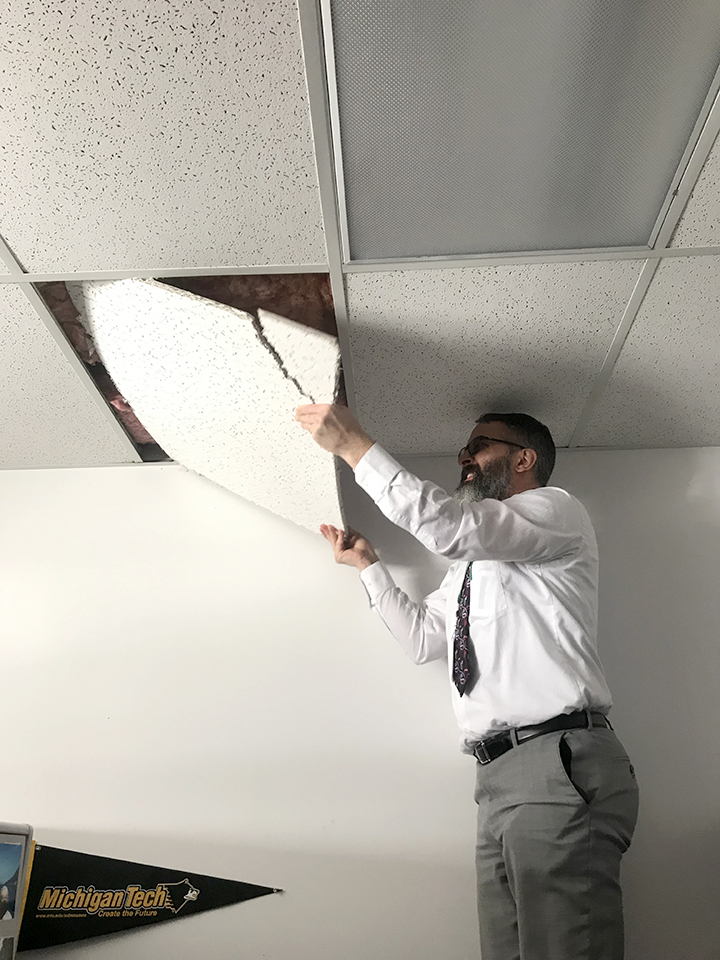
News Photo by Julie Goldberg Scott Reynolds, superintendent of the Alpena-Montmorency-Alcona Educational Service District, on Monday holds a ceiling tile that’s falling apart.

ALPENA — The Alpena-Montmorency-Alcona Educational Service District has worked the past few months to put its administrative building back together.

From July to October, the district dealt with mold, damaged windows, water damage, and a section of ceiling tile collapsing at the building on U.S.-23.

Some employees are working in the building, while others are working in surrounding K-12 school districts. The district has worked to reopen the building to all of its employees.

The building is open to the public for district-related business, but rooms cannot be reserved for public use.

Mold was found in July when crews were doing minor renovations to the building. The mold was found on wallpaper when removing drywall and insulation, so siding was removed and the damaged area got a new moisture barrier, along with new siding.

The district found in August that two windows had damaged casings and a few other windows had gaskets that failed because they outlived their lifespan.

A section of ceiling tile collapsed in October. ESD Superintendent Scott Reynolds said Monday that was caused by a combination of the ceiling tile grid not being secured with insulation laying on top of it.

“We’ve been fortunate where we never had an issue where anyone was injured,” Reynolds said. “We’re fortunate that we’re able to get everything fixed.”

Water damage was found in the main vestibule of the building, so the district removed some of the wood and replaced that.

The total cost of all of those projects is $86,429, according to numbers provided by the district. Insurance is covering $21,332, so the district is paying $65,097.

The district has had to make some adjustments to its budget because of the projects, but Reynolds said the district has enough cash on-hand to cover the needs.

“Thankfully, it’s not going to have an impact on operations,” Reynolds said. “Generally, when we have facilities repairs, those are one-time expenses, and, so, if an organization has planned in advance and is able to anticipate, like our board and administration did, it puts us in a better position. But you can never predict when surprises can come up in a facility.”

Reynolds said it’s too early to define a clear return to normalcy for the building, but he is hopeful that it may be fully open by April.

“I think that staff would be happy to get back into the building and the community will be able to see that we’ve been reasonable in use of the funds to take care of some of the basic necessities of the workplace,” he said.

Julie Goldberg can be reached at 989-358-5688 or jgoldberg@thealpenanews.com. Follow her on Twitter @jkgoldberg12.

source https://www.thealpenanews.com/news/local-news/2020/02/esd-works-to-put-its-building-back-together/

Создайте подобный сайт на WordPress.com
Начало работы