Warren court employees say workplace causing health issues — C&G Newspapers

Fans and dehumidifiers were brought to the 37th District Court building by a commercial property restoration company after water entered the basement of the building during heavy rain in January.

Advertisement

WARREN — With its leaky basement, cramped courtrooms and security concerns, many employees are just plain sick of Warren’s outdated 37th District Court building.

Some even claim they’re getting sick from it.

Runny noses. Sore throats. Allergies. A group of court workers, several of whom asked that their names be withheld from this report, said they continually experience uncomfortable symptoms that coincide with their arrival at work.

“Twenty minutes later, my nose would start running,” one employee said. “I’ve had symptoms for three or four years, easy.”

It’s no secret that water enters the basement of the building on Common Road, east of Van Dyke Avenue, in times of heavy rain or quick thaws. Employees say it comes in at the northwest corner of the basement and that it has in the past flowed through a tunnel that connects the courthouse with the lower level of Warren’s police headquarters.

While some events are worse than others, several employees suspect the musty conditions and residual mold left behind after decades of dampness are affecting their health.  

“We’re running out of sick days, a bunch of us,” the same employee said. “I’ve tried to work through it. In December, I had two and a half no-pay days. I’ve used every single sick and vacation day as a sick day. I haven’t taken a vacation since I’ve been here.”

Another employee with autoimmune conditions spoke of frequent fatigue, headaches and vomiting at work.

“I get a headache almost every day that I work. I’d often have a runny nose or a sore throat, which I believe is from mold in the building,” a third employee said. “I’m also allergic to mold.”

A “nonintrusive” mold inspection conducted in February 2017 by a licensed contractor, hired by former 37th District Court Chief Probation Officer Gregg Wilczynski, who retired last spring, found mold in various areas of the building’s lower level. According to the summary, a visual inspection of the interior walls showed signs of water damage. White and dark powdery substances “suspicious of mold” were identified in two locations, and a randomly selected file from a water-damaged box “showed signs of mold.”

The report’s summary indicated that “various types of mold were detected in the air quality tests that are known to have adverse effects on humans,” but that “levels in the air were consistent with normal fungal ecology and showed no elevated presence of airborne mold spore concentrations existing at the time of testing.” The indoor relative humidity (43.6%) and temperature (72 degrees) were both found to be “within the normal comfort parameters,” according to the report.

The report did note that the findings were only a “snapshot” of conditions at the time of testing and that any conditions resulting in the loss of moisture control, including water intrusion, could result in microbial growth.

“The workers were getting sick. They were complaining of respiratory issues, breathing problems, coughing. Some people were even taking off work because of it,” Wilczynski said in December. “I did it in good faith. I did it for us, for the workers, not because I wanted to be a savior, because something needed to be done.”

A second indoor environmental quality report was conducted last August, and a discussion about the findings of the assessments, building maintenance, water infiltration, potential remediation and best-practice recommendations was included in a letter to 37th District Court Administrator Annette Gattari Ross dated Dec. 6. The letter was sent in response to a confidential employee request for a National Institute for Occupational Safety and Health, or NIOSH, health hazard evaluation of the court building.

According to background material summarized in the letter, the building flooded three times: on Aug. 11, 2014; July 8, 2016; and July 6, 2019. The summary indicates that employees first reported health symptoms after the 2014 flood and that they worsened after the later events. It was also noted that a Michigan Occupational Safety and Health Administration, or OSHA, complaint was filed after the floods out of concern for poor air quality resulting from possible mold in water-damaged boxes and inadequate cleaning.

As part of the discussion, the letter states that “research has found that damp building conditions can lead to respiratory illnesses in occupants,” and that “damp building conditions promote the growth of mold, bacteria, other microbial agents, dust mites and cockroaches.” It states that dampness can also contribute to the breakdown of building materials and furniture, and that occupants of damp buildings can be exposed to pollutants in the air from both biological contaminants and the breakdown of building materials.

Building-related symptoms were addressed in the letter, which indicates that “comprehensive reviews have been conducted of previous scientific studies evaluating the development of health effects associated with exposures from damp indoor conditions.” It further states, “The findings include associations with upper and lower respiratory symptoms, asthma development and exacerbation, hypersensitivity pneumonitis, respiratory infections, allergic rhinitis, bronchitis, and eczema.”

The letter indicates that NIOSH does not recommend using air sampling for mold as part of a building air quality evaluation because no health-based exposure limits for biological contamination in the United States have been set by OSHA or recommended by NIOSH. It also states that measurements are highly variable and dependent on the life cycle stages of a mold species. It states that “in many cases, short-term sampling for mold spores is conducted;  however, the results might not be representative of actual exposures. Furthermore, spore counts and culture results, which tend to be what are included in indoor air quality reports, do not capture the full range of exposures.”

With regard to the findings of such reports, the letter states, “What building occupants react to is largely unknown. It can be mold, a compound produced by mold, something related to bacteria, or compounds that are released into the air when wet building materials break down.”

“We have found that thorough visual inspections or detection of problem areas by musty odors are more reliable,” the letter states.

Chief Judge John Chmura, of the 37th District Court, said any flooding at the building is addressed immediately by a commercial property restoration contractor. The most recent incident occurred during extremely heavy rain on Jan. 13. He said he was aware of the mold inspection sought in 2017, but that no employees had brought their concerns about the building to him.

“Short term, that’s the best thing we can do. Long term is we’re getting a new building,” Chmura said. “But beyond that, there’s nothing else we’re going to do because there’s got to be some proof, whatever problem they have — and again, I don’t know what they are — is caused by this particular species of mold.”

While, according to the mold inspection report, stachybotrys, or “black mold,” was identified in a sample collected in the file room in 2017, Chmura said it had not been shown that any particular species of mold was causing health problems for employees.

“I would have to have something from a doctor that says this employee is suffering this condition directly as a result of this species of mold that happens to be present in the courthouse. I don’t have anything close to that. Not even remotely close,” Chmura said. “It doesn’t make sense to spend any sort of money to get rid of a problem that may or may not exist, and quite honestly probably doesn’t exist, unless there’s some evidence to indicate that.

“We are, in a larger sense, taking care of the problem by getting a new courthouse,” Chmura said.

He estimated the cost of constructing a new court building to be roughly $20 million. The court currently has about $10 million set aside in a special building fund, accumulated through fees assigned through judgments in criminal cases over the years.

Chmura said the opening of the new courthouse could be two years away. A request for proposals has gone out, with a deadline set for next month. After that, a committee will review the proposals and select an architect for the project. Three sites are reportedly being considered: the current building footprint, land just east of the courthouse, and space to the west between the police headquarters and Civic Center Drive.

Beyond its history of routine leakiness and courtrooms that are in most cases far too small to accommodate the 37th District Court’s 21st century caseload, security remains a pressing issue. On the busiest days, county prisoners are led into the building chained together in shackles and leg irons. While under the guard of deputies, city police and armed court security officers, prisoners enter the courtrooms through public spaces filled with litigants and attorneys, not to mention friends and family members of both crime victims and the accused.

Warren Mayor Jim Fouts said the administration is in the process of reviewing building maintenance operations. He encouraged any employee with concerns about their health as it relates to a city workplace to contact the city’s Human Resources Department through its director, George Dimas.

Advertisement

source https://www.candgnews.com/news/warren-court-employees-say-workplace-causing-health-issues—116758

Library in California Reopens After 2018 Fire Causes Extensive Water and Smoke Damage and the Need to Address Asbestos — WebWire

Late last year, the Contra Costa County Library announced the reopening of their El Sobrante location after the library had been closed for almost two years. Back in early 2018, a fire caused extensive smoke and water damage. The building, originally constructed in the early 1960s, was gutted down to its studs and rebuilt into a modern library.According to an article in the East Bay Times, an asbestos abatement was also required during the rebuilding efforts in the course of reopening. This is not surprising as the Environmental Protection Agency (EPA) reports that buildings constructed before 1970 are more likely to contain asbestos. Airborne asbestos can cause lung cancer and mesothelioma, a cancer of the chest and abdominal linings. Pipe or other insulation, ceiling tiles, exterior siding, roof shingles and sprayed on-soundproofing are just some of the many materials found in older buildings that may contain asbestos.

source https://www.webwire.com/ViewPressRel.asp?aId=254256

Park City Water Damage Cleanup Service Emphasizes the Importance of Hiring a Reputable Water Cleanup Company — StreetInsider.com

[unable to retrieve full-text content]Park City Water Damage Cleanup Service Emphasizes the Importance of Hiring a Reputable Water Cleanup Company  StreetInsider.com

source https://www.streetinsider.com/Press+Advantage/Park+City+Water+Damage+Cleanup+Service+Emphasizes+the+Importance+of+Hiring+a+Reputable+Water+Cleanup+Company/16399824.html

A-State indoor swimming pool to be closed due to mold problem, officials say — KAIT

“While the testing confirmed no toxic ‘black mold’ was present, it did confirm the presence of other types of mold at levels that did require cleaning to ensure occupant health and minimize damage to the pool and its air system,” officials said in the release.

source https://www.kait8.com/2020/01/30/a-state-indoor-swimming-pool-be-closed-due-mold-problem-officials-say/

Susan B. Anthony’s Childhood Home Is Getting Renovated — Smithsonian.com

Susan B. Anthony’s childhood home is fairly nondescript, with just a small placard in the stone retaining wall and a sign suspended from a post by the road advertising its connection to the famed suffragist. Here, in Battenville, New York, the young Anthony had a slew of formative experiences—from facing discrimination on the basis of sex to witnessing slavery—that informed her later activism.

After years of vacancy, water damage and mold growth, the brick house, where Anthony lived from ages 6 to 19, is slated for renovation. As Wendy Liberatore reports for the Times-Union, the New York Office of Parks, Recreation and Historic Preservation recently announced plans to commit $700,000 toward repairs.

“There is fungus growing out of the floors and walls,” former president of the Washington County Historical Society Debi Craig tells the Times-Union. “There is an issue of black mold. There is a major problem with moisture in the house.”

Craig says she has known of the house’s significance since her own childhood, when her father would point it out every time they drove past.

She recalls him saying, “Don’t forget Susan B. Anthony lived there. She’s part of the reason you can vote.”

Susan B. Anthony age 28
Susan B. Anthony, then age 28, in 1848 (Public domain)

Anthony’s father, Daniel, moved his family from Massachusetts to New York in 1826, when he was offered a job managing a local cotton mill. In 1832, Daniel started building the family home, conveniently overlooking the mill, with bricks cast onsite. The house had enough room for Daniel, his wife, their six children and his in-laws. After Anthony’s teacher refused to teach her long division and told her to learn needlepoint instead, Daniel added a homeschooling room where his children could receive a more diverse education.

Even before her father’s intervention, Anthony found ways to skirt her teacher’s limitations.

“Susan told her teacher she was cold, stood by the stove and listened to the lesson,” says Craig to the Times-Union. “She learned long division.”

While living in the Battenville house, Anthony met two enslaved individuals at a local family’s home. As a young adult, she served as a teacher and was paid $1.50 weekly—a far lower wage than her male predecessor’s $10 per week. Then, while spending a few weeks working in her father’s cotton mill as a spooler, she learned that the women’s wages were paid directly to their husbands or fathers.

“So many things happened here,” Craig tells the Post-Star’s Kathleen Phalen-Tomaselli. “She formed her opinions here.”

The financial collapse wrought by the Panic of 1837 hit the Anthonys hard. By 1839, they had been forced to sell their house, as well as personal and household items including sugar, eyeglasses, and undergarments. The family moved a few miles down the road to a former inn, where they remained until relocating to Rochester, New York, in 1845. Anthony would live in the Rochester house, where she was arrested on the front porch in 1872 for voting in a presidential election, until she died in 1906.

The Rochester house is now a popular historic landmark, but Anthony’s childhood home, which passed through various owners and periods of disuse after the family moved out, is little-known. In the 1990s, the schoolroom was replaced with an apartment, and in 2006, the house went into foreclosure. That same year, the New York Office of Parks, Recreation and Historic Preservation acquired the property for $1.

Battenville home back
Another view of Anthony’s childhood home (Clifford Oliver / The Cultural Landscape Foundation)

Since then, the house has remained unused. In 2018, however, the property was recognized by the Cultural Landscape Foundation in its Grounds for Democracy report.

“The people and events that helped shape our democracy are often strongly associated with cultural landscapes,” Charles Birnbaum, president and CEO of the Cultural Landscape Foundation, tells the Post-Star. “As we near the centennial of women’s suffrage, it’s important that a place that bore witness to one of the movement’s most consequential leaders endures.”

The $700,000 investment is a first step toward making Anthony’s childhood home a visitor-friendly landmark, but the property’s exact future remains in flux. Because the house is situated close to a busy road, its driveway is steep and unpaved. The parcel of land also lacks space for a parking lot, meaning it may not have a future as a museum.

But Craig tells the Times-Union that the building could have a future as a research center or library dedicated to women’s rights. She also hopes to create a historical Susan B. Anthony trail that would trace a path from Adams, Massachusetts, to Battenville, Seneca Falls and Rochester.

“You could make an entire week’s vacation in New York state with stops in towns like Greenwich, which have a great history,” Craig tells the Times-Union. “That’s what I’d like to see, even if the house doesn’t become a museum.”

source https://www.smithsonianmag.com/smart-news/susan-b-anthonys-childhood-home-getting-renovated-180974088/

A phoenix rises from mold: Capitol View, now leasing — City Pulse

Skyler Ashley

Two decades after a devastating fire made the building’s apartments uninhabitable, the complicated saga of Oliver Towers is receiving some much needed closure. The eight-floor apartment tower, since rebranded as Capitol View, has its renovations almost completed and is accepting rental applications, with approved applicants expected to move in between February and March.

The Eyde Co., which purchased the building in late 2015, took on a hulking behemoth of a project. Before-and-after photos reveal Capitol View’s metamorphosis from a dilapidated, deserted building into a sleek, modern apartment complex. The arduous physical labor that garnered these impressive results was handled by Lansing’s Wieland Construction.

“The damage and mold were substantial, If you were walking through the building you should have had a mask on,” Eyde Co. CFO and general counsel Mark Clouse said. “We took literally everything out. Everything you see here is brand new.”

The overall project ended up with a price tag of $14.7 million, with Eyde Co. receiving approval for a $2.4 million low-interest loan from the Michigan Economic Development Corp. and a $1.3 million Brownfield tax credit from the city, which has a duration of 12 years.

So what’s inside? Eighty-eight one-bedroom and eight two-bedroom apartments. One-bedrooms are available as a 442-square-foot studio apartment, or in larger sizes clocking in at 586 and 592 square feet. The two-bedroom option is 886 square feet. All units feature one bathroom. Pets are allowed, but there is a deposit and monthly fee. Rent begins at $900 for a studio and reaches $1515 for the most expensive two-bedroom apartments. And each unit features a full kitchen, along with a washer and dryer. Community amenities include a fitness center, bike storage, an indoor lounge and a courtyard.

If you’re a budding entrepreneur, Capitol View also has retail space available. The two partitions on the first floor of the building are 1,992 and 2,494 square feet. They can be leased individually, or as a joint unit.

Why the name change? The original Oliver Towers was subsidized housing for senior citizens; Capitol View is not. And considering the building’s address has changed to 313 Capitol Ave. from 310 N. Seymour Ave., rebranding just made sense, Clouse said.

The most important task? Preserving the vibe of the tower’s late-’60s, early-’70s architecture. While not deemed historic by any legal body, Eyde Co. didn’t want to paint over a building that’s contributed to downtown Lansing’s aesthetic since 1968. Noticeable attention to detail confirms this philosophy, such as the building’s courtyard restoration, which respectfully preserved its sycamore trees.

“The initial focus when we acquired the building was to honor the architecture. I think when people try to change the existing and turn it into something it’s not — it doesn’t look good,” Clouse said. “We asked our architects to improve what was here, not cover what was here.”

If you’re interested in living at Capitol View, applications are available at property management company Village Green’s website.

Capitol View Apartments

Now leasing

313 N. Capitol Ave., Lansing

villagegreen.com/lansing/capitol-view-apartments

source http://www.lansingcitypulse.com/stories/a-phoenix-rises-from-mold-capitol-view-now-leasing,13796

Test feed crops for dangerous mold | Outdoors — jacksonprogress-argus

Drought and/or excessive moisture can lead to the development of molds, which can produce mycotoxins. For many farmers and ranchers, the weather has been challenging for obtaining animal feed.

“Whether dealing with drought and/or excessive moisture, both can impact livestock feed with the development of molds,” said Dr. Yuri Montanholi, veterinarian and North Dakota State University-Extension beef-cattle specialist. “Molds are generally in the agricultural environment all the time. The problem occurs when molds invade developing plants or stored feeds and grow under stress, producing mycotoxins.”

Not all molds are bad. Some are not toxin producers – but filamentous mold can reduce the nutritional value of feed. Also mold spores in feeds that are agitated, for example when feeding hay, can be irritating to the respiratory system.

The toxins usually are consumed in feed or possibly inhaled to cause harm. Often the problem is long-term; cattle eat the suspect feed before producers realize they have a problem.

One can’t judge a mold-toxin problem by the color of the mold, said Michelle Mostrom, North Dakota State University veterinary toxicologist. Certain molds such as Aspergillus spp. and Penicillium spp. are green while Alternaria spp. and Cladosporium spp. are black. Fusarium spp., Diploidia spp. and some Penicillium spp. can be white.

Mold growth doesn’t always mean toxins were produced. Also molds can grow and die, and not be visually detected – yet they may have produced toxins that are in the feed.

Montanholi and Mostrom both urge producers to be aware of feed conditions for livestock, particularly this winter. If molds are present in livestock feeds, the best approach is to discard the moldy portions of the feed and feed what appears to be normal. That may not completely avoid problems because the mold may be gone but mycotoxins remain in the feedstuff.

“As a veterinary toxicologist, I would say to be proactive and test a feedstuff that appears to be moldy for mycotoxins before feeding to animals, particularly pregnant animals,” Mostrom said. “Try to collect a representative sample of the feed. The best is to collect multiple samples of grain while transporting the feed from the field to bins or to a truck, or collect multiple samples of hay or silage during feeding.”

A sample can be obtained with a probe. If feed is positive for mycotoxins, certain animals may not be affected by that particular contamination level or may be capable of metabolizing the mycotoxin. Under some situations the mycotoxin feed can be diluted to a safe level in the final ration.

“This is a great opportunity for producers to minimize issues with mycotoxins while saving feed,” Montanholi said. “The exception is aflatoxin-contaminated feed, which is potentially carcinogenic.”

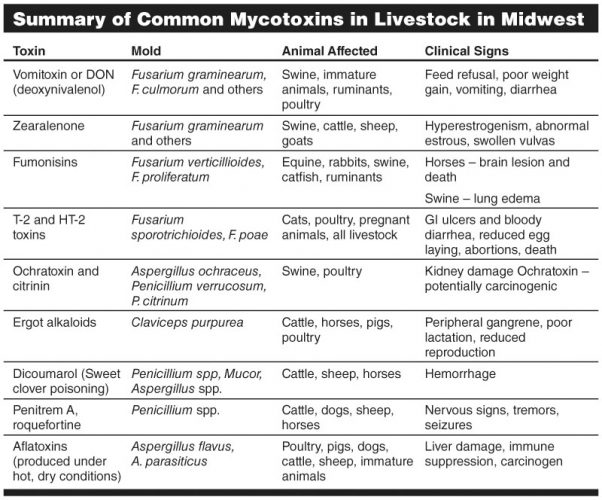
Different mold toxins can cause a variety of clinical signs in different species. An initial clinical sign of toxic feed can be feed refusal, poor weight gain and diarrhea. With continual mycotoxin exposure or exposure to extreme doses of toxins, damage can occur to the animal’s liver, kidneys, brain, fetus and other organs.

One can’t test for all mycotoxins and call a feed safe, Mostrom said.

“Scientists have discovered that these molds can produce hundreds to thousands of mycotoxins, and we do not know how all of the toxins affect animals and do not have standards or tests for all toxins,” she said. “Laboratories can test for the more-common mycotoxins that are known to cause harm in animals and provide some guidance for feeding contaminated feeds. That’s certainly a good start to minimizing problems with mycotoxins.”

Contact an Extension agent or specialist, or a veterinarian, to learn more about sampling for mycotoxin analysis, as well as for other feed analysis related to quality.

Many countries including the United States have regulatory limits or advisory guidelines on contamination of mycotoxins in human and animal feeds. Those mycotoxin limits in food and feed can vary significantly with susceptible species, age of the animal and production status.

source https://www.jacksonprogress-argus.com/news/outdoors/test-feed-crops-for-dangerous-mold/article_e5a8fbfd-f2c1-591c-b464-84f26223ba6a.html

Get livestock feed tested for mold | News, Sports, Jobs — Minot Daily News

For many farmers and ranchers, the weather has been challenging for obtaining animal feed, according to North Dakota State University Agriculture Communication.

“Whether dealing with drought and/or excessive moisture, both can impact livestock feed with the development of molds,” cautioned Yuri Montanholi, NDSU Extension beef cattle specialist. “Molds are generally in the agricultural environment all of the time. The problem occurs when molds invade developing plants or stored feeds and grow under stress, producing mycotoxins.”

Not all molds are bad. Some are not toxin producers, but filamentous mold can reduce the nutritional value of the feed. Also, mold spores in feeds that are agitated – for example, when feeding hay – can be irritating to the respiratory system.

The toxins usually are consumed in feed or possibly inhaled to cause harm. Often, the problem is a long-term one and cattle eat the suspect feed before producers realize they have a problem.

You can’t judge a mold toxin problem by the color of the mold, according to Michelle Mostrom, NDSU veterinary toxicologist. Certain molds, such as Aspergillus spp. and Penicillium spp., are green. Alternaria spp. and Cladosporium spp. are black, and Fusarium spp., Diploidia spp. and some Penicillium spp. can be white. But mold growth does not always mean that toxins were produced. Also, molds can grow and die and not be visually detected, yet they may have produced toxins that are in the feed.

Montanholi and Mostrom urge producers to be aware of feed conditions for livestock, particularly this winter. If molds are present in livestock feeds, the best approach is to discard the moldy portions of the feed and feed what appears to be normal, although this may not completely avoid problems.

“As a veterinary toxicologist, I would say to be proactive and test a feedstuff that appears to be moldy for mycotoxins before feeding to animals, particularly pregnant animals,” Mostrom advises.

“Try to collect a representative sample of the feed,” she added. “The best is to collect multiple samples of grain while transporting the feed from the field to bins or to a truck, or collect multiple samples of hay (e.g., probe) or silage during feeding.”

If the feed is positive for mycotoxins, certain animals may not be affected by that particular contamination level or may be capable of metabolizing the mycotoxin. Under some situations, the mycotoxin feed can be diluted to a safe level in the final ration.

“This is a great opportunity for producers to minimize issues with mycotoxins while saving feed,” Montanholi said. “The exception is aflatoxin-contaminated feed, which is potentially carcinogenic.”

Different mold toxins can cause a variety of clinical signs in different species. An initial clinical sign of toxic feed can be feed refusal, poor weight gain and diarrhea. With continual mycotoxin exposure or exposure to high doses of toxins, damage can occur to the animal’s liver, kidneys, brain, fetus and other organs.

You cannot test for all mycotoxins and call a feed “safe,” Mostrom said.

“Scientists have discovered that these molds can produce hundreds to thousands of mycotoxins, and we do not know how all of the toxins affect animals and do not have standards or tests for all toxins,” she noted. “Laboratories can test for the more common mycotoxins that are known to cause harm in animals and provide some guidance for feeding contaminated feeds. This is certainly a good start to minimize problems with mycotoxins.”

To learn more about sampling for mycotoxin analysis, as well as for other feed analysis related to quality, contact your Extension agent or an NDSU Extension specialist.

Many countries, including the U.S., have regulatory limits or advisory guidelines on contamination of mycotoxins in human and animal feeds. These mycotoxin limits in food/feed can vary significantly with susceptible species, age of the animal and production status.

The mycotoxin guidelines are available on the Food and Drug Administration website, or go the National Grain and Feed Association website at ngfa.org and look up FDA Guidance on Mycotoxins, or contact your local veterinarian or the NDSU Veterinary Diagnostic Lab.

source https://www.minotdailynews.com/news/local-news/2020/01/get-livestock-feed-tested-for-mold/

NDSU: Get Livestock Feed Tested for Mold — Tri-State Livestock News

Drought and/or excessive moisture can lead to the development of molds, which can produce mycotoxins.

For many farmers and ranchers, the weather has been challenging for obtaining animal feed.

“Whether dealing with drought and/or excessive moisture, both can impact livestock feed with the development of molds,” cautions Yuri Montanholi, North Dakota State University Extension beef cattle specialist. “Molds are generally in the agricultural environment all of the time. The problem occurs when molds invade developing plants or stored feeds and grow under stress, producing mycotoxins.”

Not all molds are bad. Some are not toxin producers, but filamentous mold can reduce the nutritional value of the feed. Also, mold spores in feeds that are agitated, for example when feeding hay, can be irritating to the respiratory system.

The toxins usually are consumed in feed or possibly inhaled to cause harm. Often, the problem is a long-term one and cattle eat the suspect feed before producers realize they have a problem.

You can’t judge a mold toxin problem by the color of the mold, according to Michelle Mostrom, NDSU veterinary toxicologist. Certain molds such as Aspergillus spp. and Penicillium spp. are green, Alternaria spp. and Cladosporium spp. are black, and Fusarium spp., Diploidia spp. and some Penicillium spp. can be white. But mold growth does not always mean that toxins were produced. Also, molds can grow and die, and not be visually detected, yet they may have produced toxins that are in the feed.

Montanholi and Mostrom urge producers to be aware of feed conditions for livestock, particularly this winter. If molds are present in livestock feeds, the best approach is to discard the moldy portions of the feed and feed what appears to be normal. Although this may not completely avoid problems because the mold may be gone, but the mycotoxins remain in the feedstuff.

“As a veterinary toxicologist, I would say to be proactive and test a feedstuff that appears to be moldy for mycotoxins before feeding to animals, particularly pregnant animals,” Mostrom advises.

“Try to collect a representative sample of the feed,” she adds. “The best is to collect multiple samples of grain while transporting the feed from the field to bins or to a truck, or collect multiple samples of hay (e.g., probe) or silage during feeding.”

If the feed is positive for mycotoxins, certain animals may not be affected by that particular contamination level or may be capable of metabolizing the mycotoxin. Under some situations, the mycotoxin feed can be diluted to a safe level in the final ration.

“This is a great opportunity for producers to minimize issues with mycotoxins while saving feed,” Montanholi says. “The exception is aflatoxin-contaminated feed, which is potentially carcinogenic.”

Different mold toxins can cause a variety of clinical signs in different species. An initial clinical sign of toxic feed can be feed refusal, poor weight gain and diarrhea. With continual mycotoxin exposure or exposure to high doses of toxins, damage can occur to the animal’s liver, kidneys, brain, fetus and other organs.

You cannot test for all mycotoxins and call a feed “safe,” Mostrom says.

“Scientists have discovered that these molds can produce hundreds to thousands of mycotoxins, and we do not know how all of the toxins affect animals and do not have standards or tests for all toxins,” she notes. “Laboratories can test for the more common mycotoxins that are known to cause harm in animals and provide some guidance for feeding contaminated feeds. This is certainly a good start to minimize problems with mycotoxins.”

Contact your county’s Extension agent or an NDSU Extension specialist to learn more about sampling for mycotoxin analysis, as well as for other feed analysis related to quality.

Many countries, including the U.S., have regulatory limits or advisory guidelines on contamination of mycotoxins in human and animal feeds. These mycotoxin limits in food/feed can vary significantly with susceptible species, age of the animal and production status. The mycotoxin guidelines are available on the Food and Drug Administration (FDA) website, or go the National Grain and Feed Association website (https://www.ngfa.org) and look up FDA Guidance on Mycotoxins, or contact your local veterinarian or the NDSU Veterinary Diagnostic Lab.

–NDSU Extension

source https://www.tsln.com/news/ndsu-get-livestock-feed-tested-for-mold/

Rosie on the House: Repairing, patching damaged drywall — Green Valley News

No matter the age of your home, drywall damage will occur. Minor damage is a relatively easy fix. Small screw or nail holes can be patched with white toothpaste and touch painted to blend in.

Repairs to areas of major water damage are best left to the pros. You never know what kind of damage is lurking behind that drywall, such as mold which should be left to a professional mold remediation expert.

The age and condition of the paint on your wall, and stored paint from when it was applied, are the key factors in how quickly you will finish drywall repair projects. The quality of the patch work is critical to restoring drywall walls to look like new. The paint will only look as good as the surface it’s applied to. A poor patch with a poor texture match will stand out more than you’d expect, even the best paint coating.

Project Tool List:

• Utility knife or drywall saw

• 12-inch straight edge

• A level

• 4-inch putty knife

• Coarse sponge or sandpaper

• Acrylic caulk if the patch is matched up to a countertop, shower, tile finish, etc.

• Drywall pan for large amounts of mud

• Texture spray for orange peel finishes

Water-damaged drywall

Water-damaged drywall can be identified by ripples or blisters in the paint. If you feel the blisters and they aren’t solid, or if the paint starts flaking off as soon as you touch it, you likely have a water issue.

Other common signs are areas where the drywall is soft to the touch and water stains/discoloration appear. Before you start a water-damaged drywall repair, be sure to identify and fix the source of the water intrusion.

If water is getting into your wall from rain, a sprinkler that’s too close to your house, or even from a plumbing leak, you’re likely to see patches of damage on your walls near the spot of the intrusion. That’s because drywall has a paper backing, so when it gets wet, it can bubble and wrinkle, sort of like a sheet of paper does.

To diagnose the problem, place a 4-foot level across the damaged area and learn how much the sheetrock has sagged. If it’s more than about 3/8 inch, the structural integrity of the drywall is probably ruined and the section should be replaced.

If no sagging has occurred, use an awl to randomly push into the sheetrock. You should feel substantial resistance, and the awl shouldn’t be able to penetrate the sheetrock any more than 1/8 inch without excessive force. However, if the awl goes through the sheetrock much deeper than 3/16 inch, consider replacing the section.

Replace the section: Use a utility knife to cut out the damaged area, leaving a square or rectangle so it’s easy to match with a new patch of drywall. Look in the hole to see if the damage goes deeper than the drywall (to the studs, for example) and find the source of the leak so you can stop it before you fix the wall. Set up a fan near the hole and thoroughly dry the area before continuing. Cut a new piece of drywall to fit tightly into the new hole. You may have to back it with a piece of plywood. Attach the drywall and use a good-quality drywall tape to cover the seams.

Prime, paint and keep a close eye on it in case the damage returns. That could signal a more serious water problem than you suspected.

Repair the damage: If the damage is superficial, you may not have to replace the drywall. Dry the area thoroughly, sand the blisters and prime the spot with a pigmented lacquer product called KILZ which will keep the stain from bleeding through the new coat of paint.

For more do-it-yourself tips, go to rosieonthehouse.com. An Arizona home building and remodeling industry expert since 1988, Rosie Romero is the host of the syndicated Saturday morning Rosie on the House radio program, heard locally from 8 to 11 a.m. on KNST-AM (790) in Tucson and from 7 to 10 a.m. on KGVY-AM (1080) and -FM (100.7) in Green Valley. Call 888-767-4348.

source https://www.gvnews.com/lifestyle/rosie-on-the-house-repairing-patching-damaged-drywall/article_111f70e6-4128-11ea-94b0-5b2144afa476.html