Museum Of Chinese In America Archives «Very Much Salvageable» After Fire — Gothamist

The archives of the Museum of Chinese in America may be in better shape than feared, after a five-alarm fire destroyed part of the Chinatown building where they were kept.

City workers began the process of recovering the museum’s boxes from the building at 70 Mulberry Street on Wednesday. The archives, which boast 85,000 items of historical and cultural significance, were stored on the second floor of the five-story building, where a fire on January 24th destroyed the top floors and roof. Nine firefighters and one civilian suffered non-life-threatening injuries. The NYPD said the cause of the fire was not «criminal» and the investigation is ongoing.

«We are so excited to share that it looks like everything we took out of the building this morning is very much salvageable. Very much salvageable,» said MOCA President Nancy Yao Maasbach at a press conference on Wednesday, adding that 200 boxes had already been recovered. «So we had about 25 boxes get immediately sent to Allentown, Pennsylvania, where they will be immediately (put in freezers), stabilized and then freeze-dried.» The fire did not reach the archival rooms, but Maasbach had said she was most worried about water damage, mold growth and soot.

The museum itself is located at 215 Centre Street but started out in the historic Mulberry Street building and kept space there for its archives after moving in 2009. The archives contained four decades’ worth of collecting, curating and preserving historical artifacts documenting the Chinese diaspora’s growth in New York and America.

Some of the recovered boxes apparently were in good condition and needed only to be repackaged, Maasbach said. «We had about 150 boxes sent immediately to the museum where we have about 25 volunteers who are then just repositioning them, putting them in new boxes.»

The future of the building, formerly PS 23 and built in 1893, is in question, according to Department of Building Assistant Commissioner Yegal Shamash.

«There is some severe and significant fire damage to the building,» Shamash said at the press conference. «The structural stability of the building right now is not in jeopardy. But overall we do have concerns with the stability of the building long term.»

The other organizations that were displaced by the fire include the H.T. Chen & Dancers company, a senior center run by the Chinese-American Planning Council, the Chinatown Manpower job center, and the United East Athletics Association. Councilmember Margaret Chin said the organizations have all found temporary homes to continue providing services, especially to ensure the community can celebrate Lunar New Year.

«With the entire city celebrating Lunar New Year, we recognize the urgency to make sure that the needs of the displaced community group and the New Yorkers that they serve are met,» Chin said at the press conference.

H.T. Chen told reporters that his rare orchid, which had been living inside the dance studios, was the first object retrieved — and it was still alive.

With Shumita Basu/WNYC

source https://gothamist.com/news/museum-chinese-america-archives-very-much-salvageable-after-fire

Ogdensburg votes against saving Desperado’s building, will seek funds for demolition — North Country Now

BY JIMMY LAWTON
North Country This Week

OGDENSBURG – Ogdensburg will not focus efforts on restoring the deteriorating building at 212 Ford Street, despite a push from Deputy Mayor John Rishe.

The building once held Desperado’s bar.

Rishe said he is disappointed that the city didn’t do something about the deteriorating building in the heart of downtown sooner.

He said the building has historical significance to the city and that once it’s gone, it’s gone.

The building, which is crumbling in areas, has a host of issues including roof damage, water damage, mold growth, structural damage in areas.

A report from 2013 said the building may still be salvageable, but would likely not be cost effective due to presence of hazardous material such as asbestos and lead.

Because of the condition of the building, the city is seeking funds that would pay for the demolition of the buildings, which Rishe opposed.

Councilor Bill Dillagbough, who once owned the building, said he believed it was still salvageable. However, councilors Nichole Kennedy, Dan Skamperle, Michael Powers and Mayor Jeffrey Skelly disagreed.

They argue that the time to salvage the building has passed.

Kennedy told council she is in favor of preserving the city’s history, but said sometimes it’s better to move on and make way for something new.

Rishe’s resolution, which would have stopped plans for demolition and sought funds for rehabilitation, failed to pass.

source https://northcountrynow.com/business/ogdensburg-votes-against-saving-desperados-building-will-seek-funds-demolition-0274183

EXCLUSIVE: Cleanup Company of State House Mold Has Close Ties to Mattiello UPDATED — GoLocalProv

Wednesday, January 29, 2020

View Larger +

Speaker of the House Nick Mattiello

Single Source — the cleanup company hired to remove the reported mold in the State House by the Joint Committee on Legislative Services (JCLS) has strong ties to both Speaker of the House Nick Mattiello and Majority Leader Joseph Shekarchi.

As GoLocal broke on Monday night, State House records were being dumped, and the Rhode Island State Police were alerted. 

Single Source is run by Jack Pomeranz and his family, who has donated $1,500 to Mattiello and $900 to Shekarchi — amounting to nearly a third of his political donations since 2005. According to the company’s website, «Jack Pomeranz continues to share his disaster restoration industry expertise in the role of Single Source Executive Vice President of Business Development.»

In addition, Pomeranz is engaged to Mattiello’s former administrative staffer, who is now assistant to Shekarchi. She, too, is a donor to Mattiello — having donated $350 to her former boss.

She earns $83,995.86 annually according to state records.

Pomeranz is close personal friends with JCLS Executive Director Frank Montanaro.

View Larger +

PHOTO: LinkedIn

Latest in JCLS Controversy

JCLS is chaired by Mattiello — and presently, his leadership of the committee is being investigated by the Rhode Island State Police, as GoLocal first reported last week.

Mattiello’s spokesman Larry Berman issued the following statement Monday night after State Police were investigating the possible dumping of JCLS files in a dumpster outside of the State House — first reported by GoLocal.

«An employee in the JCLS office discovered black mold under her desk last week, and she was moved into another office. A steam leak was determined to be the cause of the mold. The JCLS office was evacuated today, the carpet was ripped out, and furniture and partitions contaminated by the mold were thrown out. All the employees were relocated while the repair work is being undertaken. The Department of Administration, which is in charge of the building maintenance, is supervising the project and is coordinating the effort,» said Berman. 

GoLocal has learned that the selection of the vendor to clean up the mold was made unilaterally by JCLS.

Berman tells GoLocal that the company is on the approved state vendor list.

Filippi Blasts Montanaro

House Minority Leader Blake Filippi sent a strongly worded letter to Montanaro questioning his actions regarding his actions, writing the following.

«I have come to learn that records and computer hard drives of the Joint Committee on Legislative Services (JCLS) have been removed from the JCLS office in our Staten House basement. You have provided no notice of this unusual action to me, in my capacity as a member of JCLS, and no notice to other members of JCLS.

You are a named Defendant in a pending Superior Court action, PC-2020-00508, commenced in my capacity as a member of JCLS. Of particular note is averment #19, alleging, in part, that you and Speaker Mattiello have, and continue to, unlawfully exercise the sole statutory authority of JCLS to «maintain[] the records of the General Assembly.

Even assuming you lawfully serve as the Executive Director of JCLS, the removal of JCLS records from their historical location without the permission of, or notice to, the JCLS membership, is highly improper. That you have done so in the face of the pending litigation is beyond the pale. 

In addition, please be advised that we believe these relocated documents and computers contain information that directly relate to our pending litigation, and potentially, to the reported criminal investigation(s) related to the Office of the JCLS.  I urge you to consult with your attorney regarding your obligation to preserve records under state law and the Superior Court Rules of Civil Procedure.»

Filippi Threatens Legal Action

Filippi threatened to take legal action on Wednesday.

«I hereby direct you [Montanaro] to provide the members of the JCLS with a written log of all records and computer hard drives that were removed from the JCLS offices, their current location(s), and a list of all persons with access to these locations. Given the damage created by the presence of mold to documents and hard drives, additionally please include a log of any documents or hard drives that have been destroyed. 

I also demand a written commitment that all documents and hard drives will be preserved, only accessed in the normal course of business, and that none of these items will be moved, removed or altered without prior written notice to the members of JCLS. 

If I do not hear from you by 10 AM on January 29, 2020, I will seek injunctive relief in Superior Court compelling compliance with our General Laws.»

View Larger +

View Larger +

Updated at 9:26 PM Updated at 7:01 AM

Enjoy this post? Share it with others.

source https://www.golocalprov.com/news/exclusive-clean-up-company-of-state-house-mold-has-close-ties-to-mattiello

Test feed crops for dangerous mold | State and National News — The Maryville Forum

Drought and/or excessive moisture can lead to the development of molds, which can produce mycotoxins. For many farmers and ranchers, the weather has been challenging for obtaining animal feed.

“Whether dealing with drought and/or excessive moisture, both can impact livestock feed with the development of molds,” said Dr. Yuri Montanholi, veterinarian and North Dakota State University-Extension beef-cattle specialist. “Molds are generally in the agricultural environment all the time. The problem occurs when molds invade developing plants or stored feeds and grow under stress, producing mycotoxins.”

Not all molds are bad. Some are not toxin producers – but filamentous mold can reduce the nutritional value of feed. Also mold spores in feeds that are agitated, for example when feeding hay, can be irritating to the respiratory system.

The toxins usually are consumed in feed or possibly inhaled to cause harm. Often the problem is long-term; cattle eat the suspect feed before producers realize they have a problem.

One can’t judge a mold-toxin problem by the color of the mold, said Michelle Mostrom, North Dakota State University veterinary toxicologist. Certain molds such as Aspergillus spp. and Penicillium spp. are green while Alternaria spp. and Cladosporium spp. are black. Fusarium spp., Diploidia spp. and some Penicillium spp. can be white.

Mold growth doesn’t always mean toxins were produced. Also molds can grow and die, and not be visually detected – yet they may have produced toxins that are in the feed.

Montanholi and Mostrom both urge producers to be aware of feed conditions for livestock, particularly this winter. If molds are present in livestock feeds, the best approach is to discard the moldy portions of the feed and feed what appears to be normal. That may not completely avoid problems because the mold may be gone but mycotoxins remain in the feedstuff.

“As a veterinary toxicologist, I would say to be proactive and test a feedstuff that appears to be moldy for mycotoxins before feeding to animals, particularly pregnant animals,” Mostrom said. “Try to collect a representative sample of the feed. The best is to collect multiple samples of grain while transporting the feed from the field to bins or to a truck, or collect multiple samples of hay or silage during feeding.”

A sample can be obtained with a probe. If feed is positive for mycotoxins, certain animals may not be affected by that particular contamination level or may be capable of metabolizing the mycotoxin. Under some situations the mycotoxin feed can be diluted to a safe level in the final ration.

“This is a great opportunity for producers to minimize issues with mycotoxins while saving feed,” Montanholi said. “The exception is aflatoxin-contaminated feed, which is potentially carcinogenic.”

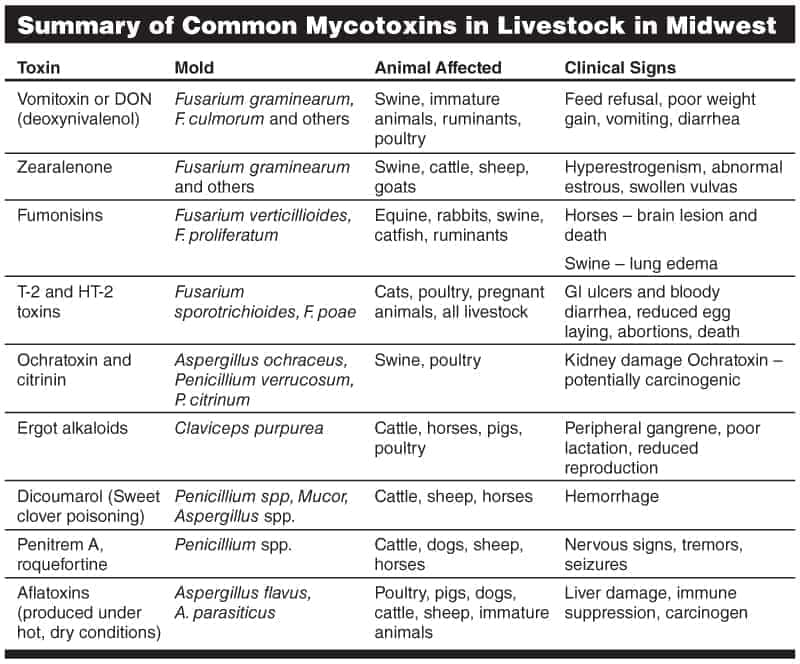
Different mold toxins can cause a variety of clinical signs in different species. An initial clinical sign of toxic feed can be feed refusal, poor weight gain and diarrhea. With continual mycotoxin exposure or exposure to extreme doses of toxins, damage can occur to the animal’s liver, kidneys, brain, fetus and other organs.

One can’t test for all mycotoxins and call a feed safe, Mostrom said.

“Scientists have discovered that these molds can produce hundreds to thousands of mycotoxins, and we do not know how all of the toxins affect animals and do not have standards or tests for all toxins,” she said. “Laboratories can test for the more-common mycotoxins that are known to cause harm in animals and provide some guidance for feeding contaminated feeds. That’s certainly a good start to minimizing problems with mycotoxins.”

Contact an Extension agent or specialist, or a veterinarian, to learn more about sampling for mycotoxin analysis, as well as for other feed analysis related to quality.

Many countries including the United States have regulatory limits or advisory guidelines on contamination of mycotoxins in human and animal feeds. Those mycotoxin limits in food and feed can vary significantly with susceptible species, age of the animal and production status.

source http://www.maryvilleforum.com/news/state_news/test-feed-crops-for-dangerous-mold/article_ead54a28-9cbd-59fe-a968-1ae4068a99c3.html

Sherborn Library project update: New construction timeline within 60 days — Wicked Local Sherborn

SHERBORN — The Sherborn Library on Sanger Street still stands empty, with an expansion left undone.

Currently, there is no work being done on the project, which began in early 2017 and was expected to be completed by the end of that year.

As the project entered its third year, with no completion date in sight, the Sherborn Select Board decided to terminate the contract of Five Star Building Corp., the contractors for the expansion, on Jan. 16.

As a result, Five Star and its subcontractors were ordered off the site.

“Five Star was terminated by the town and the bond insurance company, Travelers, was notified,” said Town Administrator David Williams via email on Jan. 27. “We then notified the Attorney General’s office and MLBC, issuer of the grant.

“The bond company will investigate the town’s complaints, and hopefully will be amicable in working with the town to replace the contractor and get construction under way again. Things are at about 70 percent completion right now, but town officials were in agreement that we needed to make some changes immediately.

“At the same time as calling the bond, we are replacing the OPM — Owner’s Project Manager. The replacement OPM has already been lined up and I am processing that contract now. This OPM was the second lowest bidder when it was originally bid three years ago. We received permission from the Attorney General’s office to use the results of the original bid process in order to not have a procurement delay. The original architect remains unchanged.

“I am hopeful we will have a new, updated construction timeline and cost estimate within 60 days. But that timeframe is based on my desire, and not a guarantee made by anyone.”

‘Repeated failure’

The reason for the termination, according to a letter sent by the Select Board, was “due to FSBC’s repeated failure to supply enough property skilled workers, failure to prosecute the work timely and in a workmanlike manner, disregard of applicable laws and codes, performance of and failure to correct defective work, poor workmanship, and other material branches of the contract.”

The letter provided further details of Five Star’s deficiencies on the project, including:

… failure to properly install the foundation and footings;

… failure to properly install granite curbs, requiring replacement;

… improper fabrication and installation of the library’s windows, which required the removal;

… substantially defective masonry work, and failure to correct that work;

… proceeding with interior work in violation of the contact and building code, failing repeatedly to maintain adequate weather protection and heat for the building, resulting in water infiltration and significant water and mold damage;

… failure to properly install flashing at the skylight/chimney interface, resulting in water damage;

… improper installation of roof decking;

… failure to comply with its obligation to procure property insurance as required by Article 11 of the General Conditions and Supplementary Conditions; and failure to keep the building weather tight and maintain and enforce a no-smoking ban, making it impossible to procure adequate property insurance for the library building and work.

“FSBC’s poor workmanship has resulted in substantial delay in completion of the project and significant monetary damages to the town,” the letter said.

The letter added that the town may have to shell out $1 million for additional costs for architectural, project management, and expert/consultant services.

What happens now

According to an update provided by the Sherborn Library Board of Trustees, town officials are working with the town counsel at KP Law on the next steps, and the library trustees and Williams have notified the Mass. Board of Library Commissioners on the project’s status. The town is expecting the final portion of the $3.6 million grant from the MBLC.

The library continues to run out the first floor of the Sherborn Community Center; its lease runs through February.

For updates on the project, visit sherbornlibrary.org.

source https://sherborn.wickedlocal.com/news/20200129/sherborn-library-project-update-new-construction-timeline-within-60-days

1-800 WATER DAMAGE Ranked a Top Franchise in Entrepreneur’s Annual Franchise 500® — PRNewswire

ANN ARBOR, Mich., Jan. 28, 2020 /PRNewswire/ — 1-800 WATER DAMAGE®, a national leader in the property restoration and water damage remediation industry, was recently ranked in Entrepreneur magazine’s Franchise 500® for the second time. In its 41st year, Entrepreneur‘s Franchise 500® is the world’s first, best and most comprehensive franchise ranking.

1-800 WATER DAMAGE’s ranking demonstrates its exceptional strength and growth as a franchise brand. Providing 24/7 residential and commercial emergency services for water and flood damage restoration, mold remediation, fire and smoke damage restoration, sewage cleanup, carpet and upholstery cleaning, and tile and grout cleaning, 1-800 WATER DAMAGE is owned and managed by BELFOR Franchise Group, a division of BELFOR Property Restoration.

«It is a true privilege for 1-800 WATER DAMAGE to have the distinction of being recognized in Entrepreneur’s Annual Franchise 500®,» said Rusty Amarante, President of BELFOR Franchise Group. «Our mission and work are centered around dedication to excellence, from providing quality disaster restoration services to offering outstanding business opportunities for our network of franchisees.»

Placement in the Franchise 500® is a highly sought-after selection in the franchise industry, which ranks franchises based on their performances in areas including unit growth, financial strength and stability, and brand power. To view 1-800 WATER DAMAGE in the full rankings, visit www.entrepreneur.com/franchise500. For more information or to contact 1-800 WATER DAMAGE, please visit https://www.1800waterdamage.com/ or call (800) 928-3732.

About 1-800 WATER DAMAGE

1-800 WATER DAMAGE® is a growing leader in the property restoration industry offering water and flood damage restoration; mold damage remediation; fire and smoke damage restoration; and carpet and upholstery cleaning services. With locations from coast-to-coast, our team of dedicated experts are «Restoring What Matters Most» for homeowners and business customers, 24/7/365. The 1-800 WATER DAMAGE® brand is owned and managed by BELFOR Franchise Group, a division of BELFOR Property Restoration, the world’s largest disaster restoration company. BELFOR Franchise Group is also the parent organization of DUCTZ and HOODZ, both leaders in their respective fields of air duct cleaning and commercial kitchen exhaust hood cleaning. For more information, please visit www.1800WATERDAMAGE.com. «Like» 1-800 WATER DAMAGE  on Facebook or «Follow» @1800WaterDamage on Twitter and @1800waterdamage on Instagram. 

CONTACT:
Alexandra Gort

BELFOR Property Restoration

610.529.1502
alexandra.gort@us.belfor.com

Victoria Schaffer

Brian Communications

484.385.2983
vschaffer@briancom.com

SOURCE 1-800 WATER DAMAGE

Related Links

http://www.1800WATERDAMAGE.com

source https://www.prnewswire.com/news-releases/1-800-water-damage-ranked-a-top-franchise-in-entrepreneurs-annual-franchise-500-300994495.html

Get Livestock Feed Tested for Mold — newsdakota.com

Image and content provided by NDSU Extension

For many farmers and ranchers, the weather has been challenging for obtaining animal feed.

“Whether dealing with drought and/or excessive moisture, both can impact livestock feed with the development of molds,” cautions Yuri Montanholi, North Dakota State University Extension beef cattle specialist. “Molds are generally in the agricultural environment all of the time. The problem occurs when molds invade developing plants or stored feeds and grow under stress, producing mycotoxins.”

Not all molds are bad. Some are not toxin producers, but filamentous mold can reduce the nutritional value of the feed. Also, mold spores in feeds that are agitated, for example when feeding hay, can be irritating to the respiratory system.

The toxins usually are consumed in feed or possibly inhaled to cause harm. Often, the problem is a long-term one and cattle eat the suspect feed before producers realize they have a problem.

You can’t judge a mold toxin problem by the color of the mold, according to Michelle Mostrom, NDSU veterinary toxicologist. Certain molds such as Aspergillus spp. and Penicillium spp. are green, Alternaria spp. and Cladosporium spp. are black, and Fusarium spp., Diploidia spp. and some Penicillium spp. can be white. But mold growth does not always mean that toxins were produced. Also, molds can grow and die, and not be visually detected, yet they may have produced toxins that are in the feed.

Montanholi and Mostrom urge producers to be aware of feed conditions for livestock, particularly this winter. If molds are present in livestock feeds, the best approach is to discard the moldy portions of the feed and feed what appears to be normal. Although this may not completely avoid problems because the mold may be gone, but the mycotoxins remain in the feedstuff.

“As a veterinary toxicologist, I would say to be proactive and test a feedstuff that appears to be moldy for mycotoxins before feeding to animals, particularly pregnant animals,” Mostrom advises.

“Try to collect a representative sample of the feed,” she adds. “The best is to collect multiple samples of grain while transporting the feed from the field to bins or to a truck, or collect multiple samples of hay (e.g., probe) or silage during feeding.”

If the feed is positive for mycotoxins, certain animals may not be affected by that particular contamination level or may be capable of metabolizing the mycotoxin. Under some situations, the mycotoxin feed can be diluted to a safe level in the final ration.

“This is a great opportunity for producers to minimize issues with mycotoxins while saving feed,” Montanholi says. “The exception is aflatoxin-contaminated feed, which is potentially carcinogenic.”

Different mold toxins can cause a variety of clinical signs in different species. An initial clinical sign of toxic feed can be feed refusal, poor weight gain and diarrhea. With continual mycotoxin exposure or exposure to high doses of toxins, damage can occur to the animal’s liver, kidneys, brain, fetus and other organs.

You cannot test for all mycotoxins and call a feed “safe,” Mostrom says.

“Scientists have discovered that these molds can produce hundreds to thousands of mycotoxins, and we do not know how all of the toxins affect animals and do not have standards or tests for all toxins,” she notes. “Laboratories can test for the more common mycotoxins that are known to cause harm in animals and provide some guidance for feeding contaminated feeds. This is certainly a good start to minimize problems with mycotoxins.”

Contact your county’s Extension agent or an NDSU Extension specialist to learn more about sampling for mycotoxin analysis, as well as for other feed analysis related to quality.

Many countries, including the U.S., have regulatory limits or advisory guidelines on contamination of mycotoxins in human and animal feeds. These mycotoxin limits in food/feed can vary significantly with susceptible species, age of the animal and production status. The mycotoxin guidelines are available on the Food and Drug Administration (FDA) website, or go the National Grain and Feed Association website (https://www.ngfa.org) and look up FDA Guidance on Mycotoxins, or contact your local veterinarian or the NDSU Veterinary Diagnostic Lab.

source https://www.newsdakota.com/2020/01/28/get-livestock-feed-tested-for-mold/

Fix Roof Leaks ASAP: How a Leaking Roof Affects Your Entire Home — Patch.com

Owning a home comes with a lot of maintenance. There are the «must-do» items like fixing leaky faucets or a broken railing, replacing broken appliances or a leaking roof… the list goes on.

All of this is on top of regular maintenance like mowing the lawn, cleaning your gutters, and the week-to-week cleaning that helps keep everything in order! It can all be daunting, and the tasks can easily pile up quickly.

With everything you have to do, it’s tempting to procrastinate on getting certain things done. Maybe you can wait on fixing a squeaky door. But something that you should never procrastinate is needing to fix roof leaks.

Roof leaks affect the entire home and can cause serious damage. Not only that, but the water damage caused by leaky roofs can be extremely dangerous for your safety and your health.

How is that possible? How can a little leaking roof cause such big damage?

Keep reading to find out.

Attic and Ceiling Damage

No pun intended: Let’s start from the top (and perhaps the most obvious). When your roof leaks, it means that water is seeping through and into your home. The roof is meant to keep this water out of the home, so when there’s a leak, it isn’t doing its job.

If you have an attic, the water can leak right into the room itself. This can damage the wood and structure of the attic itself. If you have items stored in the attic, the leak can destroy or damage these items as well.

If you don’t have an attic, the top-most part of your home is still in danger. Water can damage the ceilings directly below your roof.

Think you have a leak but aren’t sure? Look for dark spots or bubbling in the paint on the ceiling. These are signs of water damage that could be a result of a leaky roof.

You could also see damage to nearby walls, plaster, and paint. Have ceiling fans, lights, or hooks? Chances are you’ll see damage there, too, if you don’t fix the roof leak ASAP.

Insulation Damage

Underneath the roof and in the attic are prime spots for your home’s insulation. When insulation comes in contact with water (like it would if you have leaking roof) it becomes much less effective.

Reduced effectiveness of your insulation makes it harder to heat and cool your home effectively, which can lead to increased energy bills. You may also need to replace this insulation if the damage is bad enough, which increases the costs of the overall repair.

As the damage becomes more extensive, the damage to your insulation can spread to the walls and other areas in the home besides just the attic.

Mold & Mildew Growth

Mold and mildew thrive in humid conditions. Guess what’s much more humid when you allow water in through a roof leak? That’s right: your home.

As water seeps into your home through a leaking roof, it provides a breeding ground for mold and mildew to grow inside. Once the mold gets in, it can easily infiltrate your entire home through your vents, HVAC system, and even just in the air.

Mold and mildew can damage your flooring, carpets, your home structure, tiles, walls, paint… the list goes on and on. Not only will mold and mildew result in damage to the home, but it can also cause health issues for you and your family.

These health issues can range from allergy-like symptoms to headaches to serious issues like respiratory problems, lung disease, asthma, and nosebleeds.

Structural Problems

Perhaps the most serious issue caused by a leaking roof is damaged structural integrity of your home. Under extreme conditions, water damage can cause joists, rafters, frames, beams, and your entire home’s structure to deteriorate and rot. This can cause entire walls and ceilings to simply fall or break away, which is very dangerous.

Not only could this hit you or a family member as it falls, the momentum can destroy anything in its path including electronics, floors, beds, and other household objects.

Not only is it dangerous, but it’s also extremely expensive to fix this kind of damage. You may need to replace your entire roof frame, rafters, walls, and parts of the ceiling if you don’t fix roof leaks promptly.

Higher Bills

You might think you’re being smart by putting off your roof repair in lieu of fixing something else in your home. But putting off fixing a leaky roof will actually result in you spending more money in the long run.

First of all, you’ll be paying higher energy bills thanks to the damaged insulation. Damaged insulation means you need to use more energy to properly heat and cool your home.

The increased humidity thanks to the roof leak could mean you need to use dehumidifiers to offset the moisture, which also uses more power (and costs you more money).

Besides the energy bills, as the leak gets progressively worse over time (which it always will), the damage it causes is going to get more and more expensive. What might’ve started as a simple shingle repair could turn into having repairs on the entire structure and framing of your roof or home.

Don’t forget about all the damage that a leaking roof can cause that will also need to be repaired alongside the leak that started it all. This stuff adds up.

Need Roof Repair to Fix Roof Leaks? Call Farina Roofing

Have we convinced you to fix roof leaks ASAP? We hope so.

Roof leaks might seem small and innocuous, but they can actually cause immense (and expensive) damage throughout your home.

Make sure you keep up with your roof maintenance before you need an entire roof replacement.

If you’re in need of a roof repair, call us. We can come and evaluate your problem and work out the best solution for you.


This post is an advertorial piece contributed by a Patch Community Partner, a local sponsor. The views expressed in this post are the author’s own.

For more about Community Partner, click here.

source https://patch.com/massachusetts/arlington/fix-roof-leaks-asap-how-leaking-roof-affects-your-entire-home

1-800 WATER DAMAGE Ranked a Top Franchise in Entrepreneur’s Annual Franchise 500® — Yahoo Finance

ANN ARBOR, Mich., Jan. 28, 2020 /PRNewswire/ — 1-800 WATER DAMAGE®, a national leader in the property restoration and water damage remediation industry, was recently ranked in Entrepreneur magazine’s Franchise 500® for the second time. In its 41st year, Entrepreneur‘s Franchise 500® is the world’s first, best and most comprehensive franchise ranking.

1-800 WATER DAMAGE’s ranking demonstrates its exceptional strength and growth as a franchise brand. Providing 24/7 residential and commercial emergency services for water and flood damage restoration, mold remediation, fire and smoke damage restoration, sewage cleanup, carpet and upholstery cleaning, and tile and grout cleaning, 1-800 WATER DAMAGE is owned and managed by BELFOR Franchise Group, a division of BELFOR Property Restoration.

«It is a true privilege for 1-800 WATER DAMAGE to have the distinction of being recognized in Entrepreneur’s Annual Franchise 500®,» said Rusty Amarante, President of BELFOR Franchise Group. «Our mission and work are centered around dedication to excellence, from providing quality disaster restoration services to offering outstanding business opportunities for our network of franchisees.»

Placement in the Franchise 500® is a highly sought-after selection in the franchise industry, which ranks franchises based on their performances in areas including unit growth, financial strength and stability, and brand power. To view 1-800 WATER DAMAGE in the full rankings, visit www.entrepreneur.com/franchise500. For more information or to contact 1-800 WATER DAMAGE, please visit https://www.1800waterdamage.com/ or call (800) 928-3732.

About 1-800 WATER DAMAGE

1-800 WATER DAMAGE® is a growing leader in the property restoration industry offering water and flood damage restoration; mold damage remediation; fire and smoke damage restoration; and carpet and upholstery cleaning services. With locations from coast-to-coast, our team of dedicated experts are «Restoring What Matters Most» for homeowners and business customers, 24/7/365. The 1-800 WATER DAMAGE® brand is owned and managed by BELFOR Franchise Group, a division of BELFOR Property Restoration, the world’s largest disaster restoration company. BELFOR Franchise Group is also the parent organization of DUCTZ and HOODZ, both leaders in their respective fields of air duct cleaning and commercial kitchen exhaust hood cleaning. For more information, please visit www.1800WATERDAMAGE.com. «Like» 1-800 WATER DAMAGE  on Facebook or «Follow» @1800WaterDamage on Twitter and @1800waterdamage on Instagram. 

CONTACT:
Alexandra Gort
BELFOR Property Restoration
610.529.1502
alexandra.gort@us.belfor.com

Victoria Schaffer
Brian Communications
484.385.2983
vschaffer@briancom.com

View original content:http://www.prnewswire.com/news-releases/1-800-water-damage-ranked-a-top-franchise-in-entrepreneurs-annual-franchise-500-300994495.html

SOURCE 1-800 WATER DAMAGE

source https://finance.yahoo.com/news/1-800-water-damage-ranked-150000357.html

Pender Courthouse funding continues to roll in — StarNewsOnline.com

With latest FEMA check almost confirmed and more organizations showing interest, county hopes Florence repairs will wrap up by December

FEMA’s check for just more than $1.7 million to assist in repairs to the Pender County courthouse is all but written after another meeting with Pender County officials earlier this month, and the board of commissioners expect the Golden LEAF Foundation will bring its checkbook when the tobacco settlement organization visits next week.

On top of that, representatives from the State Historic Preservation Office are scheduled to visit in mid-February, and have expressed interest in possibly helping with some of the interior work with which no other entity seems enamored.

All this means that the historic building, which was heavily damaged by Hurricane Florence in 2018, may, indeed, welcome back staff, judges, attorneys, litigants and the general public in early December as currently forecast.

The storm’s wind and rains combined to reveal a weakness that was not otherwise apparent. Water seeped in through tiny cracks and holes in the mortar of the brick building. Then, in addition to the obvious damage, water hid behind the plaster interior walls, nurturing mold and mildew.

When all is said and done, Florence will have inflicted about $6 million in damage to the courthouse, including $2.5 million for efforts to protect against future damage by moving the building’s mechanical structures – some of which had to be replaced – out of the basement to the presumably safer and drier ground floor.

The courthouse is currently covered in scaffolding as Stone Restoration crews chip away at about the top three-quarters of an inch of mortar, removing the once solid, now porous material so that new mortar can be backfilled between the bricks. The exterior work is expected to be completed by April 1 at a cost of about $865,000.

Meanwhile, about $1.5 million of restoration work on the inside, which includes removing plaster walls, is still on hold – hopefully for not much longer — while the county continues negotiations with the many entities involved with putting the courthouse back together again.

Insurance companies are involved, with the size of their final checks still being negotiated. There are payments from FEMA, whose officials are wrapping up their third look at their calculations. There is a $500,000 grant from the state and possible grants from other governmental and non-governmental agencies.

The ongoing cost and payment negotiations are the result of trying to keep county taxpayers from being on the hook for the entire $6 million expense of putting the courthouse back in working order.

Stay up to date on news as it happens: Sign up for our free breaking news email alerts

source https://www.starnewsonline.com/news/20200128/pender-courthouse-funding-continues-to-roll-in