The worst part about the mold crisis at Lackland Air Force Base is how unsurprising it is — Task & Purpose

Ask a room full of veterans and service members if they’ve lived in a barracks with unsanitary conditions, and chances are a lot of hands will shoot up in the air.

Ask if they’ve complained about those conditions and some of those hands will stay there. Then ask if the complaints went unanswered; those remaining hands will likely stay up.

Now, post video of electrical fixtures in the ceiling leaking water, and photos of moldy showers, pillows, vents, shoes, beds, fans, floors, and walls on social media, and then ask if those complaints were still ignored. Most of those hands will drop like flies.

This is the story of the mold crisis at Joint Base San Antonio-Lackland, Texas in a nutshell.


Over the last week, a string of photos, videos, and screenshots of text messages were published to the popular Air Force amn/nco/snco Facebook page indicating significant issues with mold in dorm housing at the training command.

Those posts quickly garnered the attention of local papers, national news affiliates, and military news publications. After images and video documenting the mold, as well as water damage in some of the facilities at Lackland, came to light, the service mandated inspections at the other buildings on Joint Base San Antonio, which boasts 77 dorms with bed space capable of housing 27,000 service members.

Home to the Air Force’s Air Education and Training Command, Lackland is one of three installations that fall under Joint Base San Antonio, the other two being Fort Sam Houston, and Randolph Air Force Base.

So far the service has «inspected 7,080 of 8,279 rooms/open bays across JBSA, and have found the presence of mold in 1,146 rooms, approximately 14%,» according to a July 30 statement and video published to the Facebook page of Brig. Gen. Laura Lenderman, the commander of the 502nd Air Base Wing which oversees the joint base.

While the exact type of mold found in the dorms has not been «medically identified,» more than 220 airmen have been relocated from their rooms as of July 30, with more expected to follow, Jennifer Gonzalez, a spokeswoman with AETC told Task & Purpose.

«Base leaders are actively working a relocation plan that includes relocating residents to other on-base facilities and potentially off base,» she said.

Personnel with the 502nd Civil Engineer Group are «treating rooms with a regimen that includes a bleaching process as well as utilizing dehumidifiers, removing and replacing carpet with vinyl planks, and installing ceiling fans,» according to a July 30 Air Force statement.

The media coverage appears to have prompted the Air Force to recommend that other installations across the service conduct inspections at their base dorms.

«Leveraging lessons learned, the Air Force Civil Engineer Center shared the Joint Base San Antonio experience along with a recommendation that other installations also inspect their dormitories,» Robert J. Leese, a spokesman for the Secretary of the Air Force, told Task & Purpose.

«Additionally, the Air Force is inspecting Air Force dormitories in high-risk areas both within and outside of the United States to gauge the extent of mold problems,» he added. «Results of those inspections will inform any additional actions to protect the health and well-being of our Airmen.»

Despite the efforts of commanders with the 502nd to deal with the mold and to ensure healthy and safe conditions for the service members who live, work, and train on base, there’s both concern and frustration that Air Force officials only took action once the issue became public.

Recent posts about the mold at Lackland on the 502nd Air Base Wing commander’s Facebook page are riddled with comments from current and former airmen and their families, which largely amount to: We’ve been complaining about this for a while now. Case in point: these photos from four years ago that were shared by Air Force amn/nco/snco:

According to a statement from the Air Education and Training Command, the «502nd [Air Base Wing] command team was made aware of the situation on July 23 and we are thankful to the Airmen who brought this issue to light.»

However, Air Force amn/nco/snco posted a series of screenshots on July 26 purportedly showing an excel spreadsheet noting mold in dorm rooms at the Lackland dormitories that was dated July 11, 2019 — more than two weeks before the 502nd was reportedly informed of the issue.

A spokesperson for AETC did not respond to request for comment on the slide’s authenticity at the time of publication.

«The [Military Training Leader] who sent it to me said that’s pretty much been the condition for the last few years, since he’s been there, and he mentioned the MTL before him said ‘yeah, it’s pretty much been like that since my tour,'» the administrator for Air Force amn/nco/snco, himself a retired senior noncommissioned officer, told Task & Purpose by phone, under the condition that his name not be used. «It’s been going on, minimum, since 2014, but so many people commented and messaged me, that it seems to go back over a decade, easily.»

«You have to think about this, these dorms, they get inspected constantly,» he said, adding that he’s received messages from between 20 and 30 airmen who are currently at Lackland. «They’ve been tracked and I have no doubt that this has been known and kicked down the road for a long, long time. It’s almost laughable to think that, supposedly, that it’s been known now since July 23, 2019.»

Regardless of when commanders at Joint Base San Antonio became aware of the mold issues, it’s certainly being looked into now. But frankly, that reminds me an old military adage that’s usually delivered sarcastically by commanders or senior enlisted personnel at formation: If you have a problem, call your Congressman. Translation? You’re shit out of luck, and this is only getting fixed if you raise hell about it.

In light of the Air Force’s response to the mold issue at Lackland, that may need to be updated to: If you have a problem, take pictures of it and post it on Facebook. That, at least, seems to get results.

source https://taskandpurpose.com/lackland-air-force-base-mold-crisis

Tips for Porch and Deck Maintenance — Lansing State Journal

Cindy Kosloski, Greater Lansing Home Builders Association Published 4:51 p.m. ET July 31, 2019

CLOSE

Summertime provides ideal weather to enjoy the porch or deck at home. Like your home’s interior, you should keep your exterior clean and in good shape for optimal comfort. To help you enjoy your outdoor living space, here are some tips for porch or deck maintenance.

Cleaning:  Sweep your deck and remove debris trapped in between your deck boards. A simple spray of water with a garden hose can remove dirt. Bleach will discolor your deck and wire brush can damage wood. To remove mold and mildew purchase a deck cleaning solution. Some cleaners can be harmful to plants so make sure they are removed or covered before applying a solution. 

Repairing: Wear and tear from weather can damage your porch. Conduct a visual inspection for loose boards and nails. Small issues can be repaired by removing the boards, flipping and refastening them. Splinters in wood can be sanded down. If you see rotting wood under the boards, you may need to consult a professional for repairs. If your boards are cracked, it is a sign that it needs to be stained. If boards on your deck are split, you will need to completely replace the damaged board.

Staining: If your deck is cleaned and repaired you may want to consider adding a stain for a refreshed look. It is time for a new stain if your deck does not repel water easily. You should follow the manufacturer’s directions for any stain or seal you apply. Drying time depends on the temperature and humidity level.  Avoid applying any product to your deck or porch in the direct sun which will dry out the finish too quickly.

Decorating: New patio or deck décor can liven up any outdoor space. Avoid selecting natural fibers such as jute or bamboo. This type of material absorbs moisture and could lead to mildew on your deck or porch. Add rugs and mats made of recycled plastics to maximize longevity and avoid mildew. Select furniture constructed with materials designed to withstand the elements, such as cedar or teek, which are also resistant to insect damage. Metallic furniture made from iron, especially with rust-resistant coating, is another durable option. You can top off any style of furniture with pillows and cushions made of synthetic fibers which can starve off mildew or harmful UV-rays from the sun.

For more home maintenance tips to tackle early in the summer, contact the HBA of Greater Lansing at (517) 323-3254 or visit our website at hbalansing.com.

Read or Share this story: https://ift.tt/334VSEM

source https://www.lansingstatejournal.com/story/marketplace/real-estate/2019/07/31/tips-porch-and-deck-maintenance/1882293001/

Lake Arbor Apartment Residents Forced to Vacate — Spectrum News

CHARLOTTE, N.C. — Mold, water damage and bug infestations are just some of the problems that have have plagued the Lake Arbor Apartments for years. Now, residents are being forced to move out by the end of the year. 

  • Management sent letters to 177 households saying all units should be vacated by January 1, 2020
  • The letter says tenants may earn incentives for leaving peacefully, and removing all personal property
  • Management says they are offering meetings with housing solutions and other groups in Charlotte to help residents find options

Management sent letters to 177 households saying all units should be vacated by January 1, 2020.  

The letter says tenants may earn incentives for leaving peacefully, and removing all personal property. The units must also be in good condition. 

Charlotte city leaders sued the complex’s management company for failure to comply with housing codes.

New management took over earlier this year and plans to improve the property once everyone leaves. 

Management says they are offering meetings with housing solutions and other groups in Charlotte to help residents find options. Those groups include Charlotte Family Housing, Community Link and Crisis Assistance Ministry. 

The meetings to meet with housing assistance are listed below:

  • Saturday, August 3: 10 a.m. to 4 p.m.
  • Monday, August 5: 1 p.m. to 7 p.m.
  • Wednesday, August 7: 8:30 a.m. to 3:30 p.m.
  • Thrusday, Auust 8: 1 p.m. to 7 p.m.
  • Saturday, August 10: 10 a.m. to 4 p.m.
  • Monday, August 12: 1 p.m. to 7 p.m.
  • Wednesday, August 14: 8:30 a.m. to 3:30 p.m.
  • Thrusday, Auust 15: 1 p.m. to 7 p.m.

Residents interested in meeting with those groups can speak with representatives on site at the fitness center. You need to bring the following items: a photo ID, Social Security documentation, proof of household income, rental lease, and any past due bills or eviction notices

source https://spectrumlocalnews.com/nc/charlotte/news/2019/07/31/lake-arbor-apartment-residents-forced-to-vacate

Mississippi farmers suffering after widespread flooding prevents crops from being planted — Fox News

ROLLING FORK, Miss. — The time to get crops like soy beans, cotton and corn in the ground have come and gone for many farmers in the Mississippi Delta. Months of flooding from record rainfall and backed up waterways, which were shut off from draining into the Mississippi River, has flooded more than a million acres of land and squandered away the growing season.

The thought of starting over has crossed the mind of farmer Parker Adcock, 25, consistently. He stood and exhaled slowly as he looked around his home that he, his pregnant wife and their young daughter were displaced from after 10 inches of floodwater moved in this spring. The water is out of the home; however, it now sits infested with mold and insects of all sorts.

“The first time we came back and saw this, I was in tears looking at all of this,” he said. “If you’re not tied to the land, I’d be getting out.”

Parker Adcock, 25, and his family stand in front of their home. They were forced out of the home six weeks after moving in when 10 inches of water flooded it. (Fox News/ Charles Watson)

Parker Adcock, 25, and his family stand in front of their home. They were forced out of the home six weeks after moving in when 10 inches of water flooded it. (Fox News/ Charles Watson)

Leaving isn’t an option for the young farmer. He’s committed to 4,000 acres of farmland (about 6 square miles), most of which is left useless this year as it sits in slow-receding floodwater. He’s been able to plant some corn crops on about 175 acres — about 4 percent of his land — but it won’t yield him nearly enough to get him through the year.

The 25-year-old estimates his damages will total somewhere in the 7-figure range after his property damage is assessed; and even though his financial means have vanished for the year, his operational costs have not.

HURT BY US-CHINA TRADE WAR IOWA FARMERS HOPE HEMP IS THERE BIG MONEY SAVIOR

“Land owners still want their rent money, regardless of whether I made a crop or not. John Deere still wants to get paid for the tractor sitting in the shed that I never got to pull out for the year,” he said. “I have to figure out a way to come with all that and still be able to farm again next year.”

In May, Billy Whitten had been hopeful that the floodwater that had inundated more than a million acres of land in the Mississippi Delta would be gone by now. He and others hoped they would be able to get some crops planted this season. That hope has dissipated as most of his 1,400-acre farm in Valley Park, Miss. is drowning in water.

“There’s no way we can plant anything this year,” Whitten said. “It’s past the planting time.”

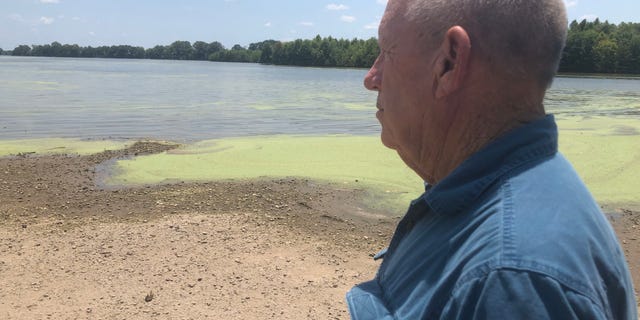
Farmer Billy Whitten stares out at his 1,400 acres of farmland that he won't be able to plant on this year. It now resembles a lake as it drowns in slow-receding floodwater. (Fox News/ Charles Watson)

Farmer Billy Whitten stares out at his 1,400 acres of farmland that he won’t be able to plant on this year. It now resembles a lake as it drowns in slow-receding floodwater. (Fox News/ Charles Watson)

Aside from his duties on his own farm, Whitten sits on the board of the Valley Park Grain Elevator. The elevator buys grain harvested buy local farmers, stockpiles it and then later sells it. However, business has been down by as much as 75 percent this year.

The 10-member board has done what it can to make sure its employees have had a source of income, but it’s getting to a point where tough business decisions are going to have to be made.

“We’ve got several employees that work there. We’re hoping that we won’t have to lay any of them off, but it’s a good chance some of them will lose their job because of this.”

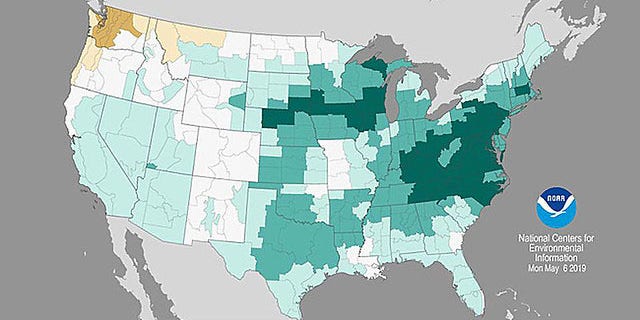
Rain and flooding have been a struggle for farmers across the country this year. From March 2018 to April 2019, an average of 36.20 inches of rain fell across the Lower 48 states — the nation’s wettest 12-month period on record, according to the USDA.

A map from the National Oceanic and Atmospheric Administration illustrating areas of the country has above average or record rainfall between March 2018 and April 2019. (NOAA)

A map from the National Oceanic and Atmospheric Administration illustrating areas of the country has above average or record rainfall between March 2018 and April 2019. (NOAA)

Corn and soybean crops have taken a hit as a result of the record precipitation. U.S. corn planting failed to reach the halfway mark by mid-May this year. For the first time on record, less than 50 percent of intended corn crops had been planted. Comparably, the USDA reported 19 percent of U.S. crops had been planted during the same time period — the lowest amount for soybeans since 1996.

Mike McCormick, president of Mississippi Farm Bureau Federation, said the difference between other farm communities that border the Mississippi River are pumps. There is no system in place to pump water out of the Mississippi Delta during record rain and flood events like this year.

TROPICAL STORM BARRY TESTS  LOUISIANA’S MULTI-BILLION  DOLLAR POST-KATRINA FLOOD DEFENSES

“It’s a chronic event for us. 41 percent of the United States is drained right by our border here in Mississippi. Because of the record amount of rainfall, we’re having, we’ve basically turned Mississippi into a flood control structure for the rest of the United States,” McCormick said. “We definitely need the pumps to help the south Delta, but we also need a new plan on the Mississippi River and how we’re going to drain it.”

The Environmental Protection Agency had planned on installing pumps in the region, but the project was vetoed in 2008. When asked about the current status of the project, the EPA said it was working on getting a response.

Adcock is trying to look ahead to the future. But his anxiety, due to this year’s flood event, is so high he’s having nightmares where he’s surrounded by water.

“It’s been mentally exhausting,” he said. “If this happens again, I’m done. Nobody can survive two years of this.”

source https://www.foxnews.com/us/mississippi-farmers-flooding-crops-planted

Multi Agency Resource Center opened in Neosho for flood victims — KoamNewsNow.com

NEOSHO, Mo. — Wanda Holguin, Neosho Resident: «My home for this particular flood was not that bad. But the prior flood that we had in 20-17, I got a lot of damage.»

Neosho resident Wanda Holguin says flooding this spring made that damage to her home worse.. and figuring out how to get her insurance to cover the damage has been pretty difficult. 

Holguin: «They just totally denied to help me, and it’s bad.»

She was at the Multi-Agency Resource Center set up by the American Red Cross in Neosho looking for some answers. 

The center was set up to give residents a chance to talk face to face with agencies like the Missouri Department of Insurance, the Missouri Department of Health and Senior Services, and FEMA.

Several non profits were also on hand. 

Julie Stolting, American Red Cross: «Maybe that mold mitigation, or maybe some fencing was knocked caught down because of the flooding. So, just asking those questions, finding those resources.»

The Newton County Emergency Manager says since flooding on June 23-rd, they’ve been hard at work getting numbers to the state for a disaster declaration — and trying to get this event off the ground.

Charla Geller, Newton County Emergency Management: «We asked for this to happen shortly after the event. Unfortunately, the Red Cross was tied up other places throughout the state, and this is the soonest they could get. If we can help one citizen, then it’s worth it.»

Stolting: «It’s usually two to four weeks after the event because you really have to see what the needs are in the community, and that’s why it can take a little bit longer.»

Holguin thinks it would have helped more people if the center was set up sooner, but is happy to see an effort now. 

Holguin: «Just the fact of them being here now is tremendous.»

The resource center will set up shop at First Baptist Church in Anderson, Missouri tomorrow from one until seven.
 

___

Get the latest local and national headlines straight to your email for free: Sign up here.

source https://www.koamnewsnow.com/news/multi-agency-resource-center-opened-in-neosho-for-flood-victims/1102110699

10 steps to prepare your RV for storage after a summer road trip — Business Insider

source
REUTERS/Carlo Allegri
  • You’ve been cruising around in your RV all summer but when it’s time to store it away, give it some well-deserved care and attention to get the most out of it on your next outing.
  • Whether you’re storing your RV close to home or someplace farther away, these handy tips from industry professionals and other RV users are a practical will help ensure your RV is ready to hit the road again later
  • As a rule, start from inside-out and top to bottom for a thorough cleaning job.
  • Visit Business Insider’s homepage for more stories.

Read on for everything you need to know about preparing your RV for storage after a summer road trip.


1. First the inside: Clear all cabinets, especially inside the kitchen and bath. Take out food, oils, spices and liquids that could result in mold growth or attract rodents.

source
Rawpixel/Getty Images

“Leaving out rodent poison or deterrents is recommended to prevent infestation but definitely avoid using mouse traps as that could leave decomposing critters stinking up your RV,” says JUCY RV Rentals General Manager Hiron Menon.


2. Remember: Also remove anything in cans or bottles that can break or expand and explode in the RV.

source
Christian Augustin/Getty Images

This includes cleaning supplies that can spill and cause damage if left inside. Turn off the refrigerator and leave the door open to avoid mold growth. Leave a box of baking soda inside to mask any odors.


3. Spring clean away: Scrub all surfaces, vacuum all carpets.

source
Monika Skolimowska/picture alliance via Getty Image

Wipe down the interior of your RV, clean all filters and vents, and dry all work and resting surfaces. Wash linens and awnings, and ensure the entire interior area is completely dry.


4. The exterior needs to be cleaned, too

source
Joe Sohm/Universal Images Group via Getty Images

Wash and dry the outer surfaces of the RV. Start from the roof down, and clean the undercarriage to free all the dirt and chemicals that have been collecting in areas not clearly visible. Get this done at an authorized RV dealer if necessary. This would also be a good opportunity to get other repairs and maintenance issues addressed, too.


5. About those windows: Cover them to keep light and heat.

source
Ian Forsyth/Getty Image

Doing this will help to avoid damage to the quality of materials on the inside. “Inspect all of the roof seams, body seams and use window sealant for any cracks and openings that would allow water to get in. Consult your RV dealer for sealants compatible with these materials and reseal as required,” says Mark J. Polk, owner of RV Education 101.


6. Battery care: Disconnect all batteries to extend their lifespan

source
Bruce Gifford / Contributor

Polk advises, “Check and adjust the water levels in all batteries and make sure they are fully charged. A discharged battery will freeze much quicker than a fully charged battery. If the RV is in long-term storage, it’s better to remove the batteries and store them where they will not freeze.”


7. Oil, fuel and tanks

source
REUTERS/Pablo La Rosa

Jody Halsted of Camping Tips for Everyone says, “If it is nearly time for an oil change, get that done before your RV sits in storage. Consider fuel stabilizers if the RV won’t be used for more than a month.” Remove water from all tanks, flush the waste tank to prevent any bad odors, and turn off the liquefied petroleum gas supply valve cylinders.


8. Cover your RV

source
Justin Sullivan/Getty Images

Find a sheltered storage spot, but if that isn’t possible, get a cover made of a breathable material that fits your vehicle. Do not park under trees or in a heavily wooded area. Natural elements can do a number on the exteriors so keep it well-protected to avoid surprise maintenance expenses.


9. Check your tires

source
Andreas Rentz/Getty Images

Inflate tires to the maximum pressure listed in the owner’s manual. Cover them to reduce UV damage. Polk suggests driving the RV onto a raised platform, such as a large piece of treated lumber underneath each tire, to create a buffer between the tires and the ground. “Frozen ground and petroleum-based surfaces, like asphalt, can damage tires.”


10. Last but not least …

source
ROBERT SULLIVAN/AFP/Getty Images

Consider some form of remote monitoring or video surveillance to keep an eye on your precious cargo hauler while it’s in storage to help protect your investment.

source https://www.businessinsider.sg/storing-your-rv-after-summer-road-trip-tips-advice-2019-7/

Get help finding damage caused by flooding — THV11.com KTHV

LITTLE ROCK, Ark. — Arkansas has experienced extreme flooding this summer. 

Those storms have left behind damage and mold at some homes but not every homeowner can spot the issues. 

Benson Restoration is offering free inspections. Need help filing an insurance claim? Benson can help with that, too!

Call 501-697-2323 or CLICK HERE for more information. 

source https://www.thv11.com/mobile/article/entertainment/television/programs/the-vine/get-help-finding-damage-caused-by-flooding/91-2a8ea3d4-03b0-4dc5-ae42-72515286df8a

Community provides input on new Palmetto Police Station — WWSB

“There’s a lot of buildings already, there a lot of abandoned buildings, there’s one down the street, there’s some by the water,” Ivan Chavez, a Palmetto homeowner said. “They’re not even using those they can use those. Why are they wasting our money on new buildings, all these new cars and new things when they can use what we’ve got and be resourceful.”

source https://www.mysuncoast.com/2019/07/31/community-provides-input-new-palmetto-police-station/

8 tips for servicing your car after a summer road trip — Business Insider

The summer road trip is an iconic American institution.

Whether a cross-country tour with the family, a trip to the beach with friends, or the long haul home from college when the second semester ends, American motorists log millions of collective miles on those summer road trips. A US Department of Transportation study found that the average recreational summer road trip sees an average of a 314-mile drive one-way on such trips, or more than 600 miles in total. Many trips, of course, measure well into the thousands of miles.

Road trips can be enjoyable and relatively inexpensive compared with air travel, but they can do a number on the car, truck, or SUV logging all those miles. To keep your vehicle in its best possible shape, you need to complete a number of car care tasks after the long drive is over, and these go beyond the routine maintenance you offer a commuter vehicle.

Here are the steps to take to service a car after a long summer road trip.

source https://www.businessinsider.com/car-maintenance-tips-after-summer-road-trip-2019-7

Here’s Why You Need to Stop Using a Steam Mop on Your Floor — Yahoo Lifestyle

Opting for the cleaning power of steam rather than harsh chemicals on your floor seems like an environmentally friendly choice. But, using steam mops on some floors can do more harm than good. It’s one of the many cleaning mistakes you’re probably making. So how do you decide where to use a steam mop and where to avoid it? Here’s the low-down on whether or not to use a steam mop.

Why use the power of steam?

Used correctly, steam cleaning is a natural and effective way to remove stubborn dirt and stains. Plus, a steam cleaner kills 99.9 percent of household germs, including salmonella, E. Coli and Staphylococcus, as well as dust mites and surface mold. Once the water reaches 175 degrees F, it will sanitize surfaces effectively and many home cleaners reach up to 245 degrees F. There are other advantages to using the power of steam for cleaning, too. For example, steam cleaning your oven avoids exposure to potentially hazardous chemicals found in some oven cleaning products. Steam cleaning your grill gates also cuts down on elbow grease. In fact, there’s a multitude of ways to use a steam cleaner safely in your home. But, when it comes to your floors, a steam mop isn’t always the best choice. Especially since your floor is one of the 16 dirtiest things in your home.

Which flooring is safe for steam-cleaning?

Steam mops work by producing steam under pressure and «forcing» it into cracks and crevices that might get missed with other cleaning methods. Flooring that has gaps or cracks (however small) is vulnerable to damage, and materials like vinyl might warp with the heat.

So, steam mops should only be used on flooring that has no such gaps and isn’t likely to warp in high temperatures. Steam cleaning works great on ceramic tile floors.

Which flooring could be damaged by steam-cleaning?

Some manufacturers claim that sealed floors won’t be damaged by using a steam mop if it’s used at low or medium pressure. But, most experts don’t recommend steam mops for wooden or laminate flooring, or for surfaces with potential gaps such as vinyl tiles or vinyl planking. A hardwood floor may have small cracks that are invisible to the naked eye. Forcing steam into gaps and cracks can cause irreparable damage such as swelling, warping, delamination, and joint-line separation. In many cases, you’ll void your warranty if you steam-clean a wooden floor or vinyl tiles. Using steam or other liquid cleaning methods can also cause a build-up of mold and mildew, perhaps leading to a musty smell as well as damage. Even engineered wood floors can be affected by using a steam mop. This extra dirt might mess with your how often you should be cleaning your floors—and everything else in your house.

How should I care for my floors?

The National Wood Flooring Association recommends you mop up spills from your floor immediately to avoid damage and potential accidents. Wooden floors can be vacuumed regularly or cleaned with a barely damp mop, giving it a good clean with proprietary wood floor cleaner once a month. After five years, you may need to re-coat your floor with another layer of your original finish to keep it pristine. Keep up the cleaning with these housecleaning hacks from professionals that you’ll want to steal.

source https://www.yahoo.com/lifestyle/why-stop-using-steam-mop-202601520.html

Создайте подобный сайт на WordPress.com
Начало работы